
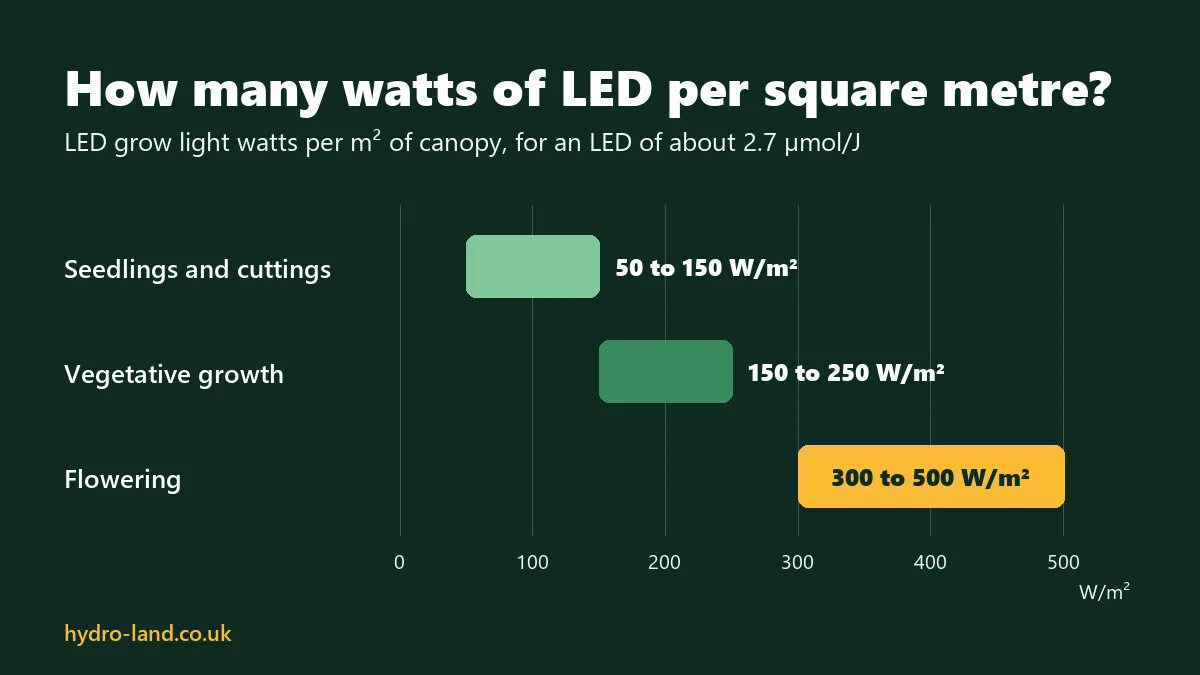
A modern LED grow light needs 300 to 500 watts per square metre of canopy for flowering, 150 to 250 W/m² for vegetative growth and 50 to 150 W/m² for seedlings and cuttings. Watts per square metre is simply the power a light draws at the wall divided by the area it lights, and those ranges assume an efficient LED of about 2.5 to 3 µmol/J.
This guide from Hydro Land shows how to work out the watts for your own growing area, why watts are only a rough guide to the light plants receive, how the right figure changes with the growth stage and with the efficiency of the light, the wattage for 7 common UK tent sizes, how to choose a light that fits, and what each watt per square metre costs to run.
Quick answer
- 1 m² tent (100 x 100cm): 300 to 500W of LED in flower, 150 to 250W in veg
- 120 x 120cm tent (1.44 m²): 430 to 720W of LED in flower, 215 to 360W in veg
- Seedlings and cuttings: 50 to 150W per square metre
How Do You Work Out LED Watts for Your Growing Area?
LED watts for a growing area are the floor area in square metres multiplied by the watts per square metre for the growth stage. The three steps are listed below.
- Measure the floor area. Multiply the length by the width in metres. A 120 x 120cm tent is 1.2 x 1.2 = 1.44 m².
- Multiply by the watts per square metre for the stage. For flowering, 1.44 x 300 = 432W and 1.44 x 500 = 720W, so the tent needs about 430 to 720W of LED.
- Check the light’s PPF against the area. The light output in µmol/s tells you whether those watts produce enough light. The PPF each tent needs is in the tent table further down.
The area that counts is the canopy, not the whole floor. If your plants only fill two thirds of a large tent, size the light for the space they actually cover, or move the plants together under it.
Why Are Watts Only a Rough Guide to Light?
Watts measure how much electricity a light draws, not how much light it puts on the plants, so the same wattage gives very different results from different LEDs. Light output is measured as PPF in µmol/s, the light that lands on the plants is measured as PPFD, and the efficiency figure in µmol/J links watts to light. The three terms are explained below.
What Is PPFD and How Much Do Plants Need?
PPFD is the amount of usable light landing on each square metre of canopy every second, measured in µmol/m²/s. It is the number plants respond to, and the target rises as they grow:
- Seedlings and cuttings: 100 to 300 µmol/m²/s
- Vegetative growth: 400 to 600 µmol/m²/s
- Flowering: 700 to 1,000 µmol/m²/s, and above 1,000 only with added CO2
The daily total is called DLI, the daily light integral. DLI equals PPFD x hours of light x 0.0036. A veg tent at 500 µmol/m²/s on 18 hours gets 32 mol per square metre a day, and a flower tent at 800 µmol/m²/s on 12 hours gets 35 mol. A PAR meter measures PPFD directly if you want to check your own canopy, and our grow light guide covers the basics of light for plants.
What Does µmol/J Mean on an LED?
µmol/J tells you how many micromoles of light an LED makes from each joule of electricity, so it is the number that turns watts into light. Budget LEDs sit at 2.3 to 2.5 µmol/J, good mid range fixtures at 2.7 to 2.9, and premium fixtures at 3.0 to 3.1. A 600W HPS kit manages about 1.7 µmol/J. A 3.1 µmol/J light gives about 35% more light from every watt than a 2.3 µmol/J light, which is why two lights of the same wattage can light very different areas. The colour of the light matters less than these numbers, as our guide to full spectrum LED explains.
Why Ignore “Equivalent Watts” on the Box?
An “equivalent watts” figure is a marketing number, so size an LED by its watts at the wall and its PPF, never by the equivalent figure. Many cheap lights sold as “1000W” or “replaces 1000W HPS” draw 100 to 200W from the socket. Put that light in a 120 x 120cm tent and the canopy gets a fraction of the light it needs. The real wall draw is printed on the driver label or in the specification.
How Many Watts of LED per Square Metre for Each Growth Stage?
LED watts per square metre rise with the growth stage, from 50 to 150 W/m² for seedlings to 300 to 500 W/m² for flowering plants. The figures below assume an LED of about 2.7 µmol/J.
| Growth stage | Target PPFD (µmol/m²/s) | LED watts per m² | Hours of light | DLI (mol/m²/day) |
|---|---|---|---|---|
| Seedlings and cuttings | 100 to 300 | 50 to 150 W/m² | 18 | 6 to 19 |
| Vegetative growth | 400 to 600 | 150 to 250 W/m² | 18 | 26 to 39 |
| Flowering | 700 to 1,000 | 300 to 450 W/m² (500 for maximum yield) | 12 | 30 to 43 |
Over a whole grow cycle, one dimmable light sized for flowering covers every stage. Run it at 25 to 50% for veg and turn it up to full power for flower. For seedlings and cuttings on their own, low power propagation lights give the gentle light they need for much less money.
How Does LED Efficiency Change the Watts You Need?
The more efficient an LED is, the fewer watts per square metre it needs, because each watt turns into more light on the canopy. The watts you need come from this formula:
W/m² = target PPFD ÷ (µmol/J x 0.85)
The 0.85 is the share of a light’s output that lands on the canopy in a reflective grow tent, with the rest lost on the walls and between plants. The table below works the formula through for common efficiencies.
| Efficiency | Example | Seedlings (200 PPFD) | Veg (500 PPFD) | Flower (800 PPFD) | Flower (1,000 PPFD) |
|---|---|---|---|---|---|
| 1.7 µmol/J | 600W HPS kit, for comparison | 138 W/m² | 346 W/m² | 554 W/m² | 692 W/m² |
| 2.3 µmol/J | Maxibright Daylight 480W | 102 W/m² | 256 W/m² | 409 W/m² | 512 W/m² |
| 2.5 µmol/J | Maxibright Daylight 300W Pro | 94 W/m² | 235 W/m² | 376 W/m² | 471 W/m² |
| 2.7 µmol/J | Gorilla 720W Gen III, Elite 300W | 87 W/m² | 218 W/m² | 349 W/m² | 436 W/m² |
| 2.9 µmol/J | Omega Black 720W Plus | 81 W/m² | 203 W/m² | 325 W/m² | 406 W/m² |
| 3.1 µmol/J | Lumatek Zeus 600W Pro 3.1 | 76 W/m² | 190 W/m² | 304 W/m² | 380 W/m² |
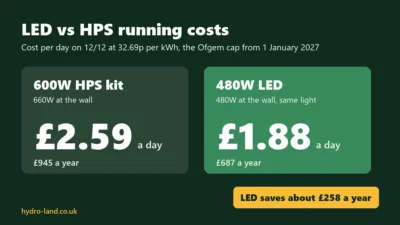
A 3.1 µmol/J light reaches 800 µmol/m²/s from about 300 W/m², while a 2.3 µmol/J light needs about 410 W/m² for the same crop. That gap also explains why old forum advice often quotes higher wattages: it was written for older, less efficient LEDs. Fewer watts for the same light also means a smaller electricity bill, as our comparison of LED vs HPS running costs shows.
LED Wattage by Tent Size: 7 Common UK Tents
The LED wattage for each common UK grow tent size is listed below for veg and flower, with the light output a fixture needs for flowering.
| Tent size | Floor area | Veg (150 to 250 W/m²) | Flower (300 to 500 W/m²) | PPF needed for flower |
|---|---|---|---|---|
| 60 x 60cm | 0.36 m² | 55 to 90W | 110 to 180W | 340 to 420 µmol/s |
| 80 x 80cm | 0.64 m² | 95 to 160W | 190 to 320W | 600 to 750 µmol/s |
| 100 x 100cm | 1.00 m² | 150 to 250W | 300 to 500W | 940 to 1,180 µmol/s |
| 120 x 120cm | 1.44 m² | 215 to 360W | 430 to 720W | 1,360 to 1,690 µmol/s |
| 150 x 150cm | 2.25 m² | 340 to 560W | 675 to 1,125W | 2,120 to 2,650 µmol/s |
| 120 x 240cm | 2.88 m² | 430 to 720W | 865 to 1,440W | 2,710 to 3,390 µmol/s |
| 240 x 240cm | 5.76 m² | 865 to 1,440W | 1,730 to 2,880W | 5,420 to 6,780 µmol/s |
The wattage ranges assume an LED of about 2.7 µmol/J. The PPF column assumes a flowering target of 800 to 1,000 µmol/m²/s. If you have not picked a tent yet, start with our guide to choosing a grow tent size.
How Many Watts of LED for a 60 x 60cm Tent?
A 60 x 60cm tent (0.36 m²) needs 55 to 90W of LED in veg and 110 to 180W in flower.
| Floor area | 0.36 m² |
| Veg watts | 55 to 90W |
| Flower watts | 110 to 180W |
| PPF needed for flower | 340 to 420 µmol/s |
- Light that fits: the Omega Infinity 2.7 Pro 200W (2.7 µmol/J, from £130), run at about 70 to 90% in flower.
- Avoid: 300W lights and larger, which cannot be dimmed far enough and waste most of their light on the walls.
How Many Watts of LED for an 80 x 80cm Tent?
An 80 x 80cm tent (0.64 m²) needs 95 to 160W of LED in veg and 190 to 320W in flower.
| Floor area | 0.64 m² |
| Veg watts | 95 to 160W |
| Flower watts | 190 to 320W |
| PPF needed for flower | 600 to 750 µmol/s |
- Budget light that fits: the Elite 300W LED (815 µmol/s, £99).
- Premium light that fits: the Maxibright Daylight LED 300W Pro (about 750 µmol/s, £420).
How Many Watts of LED for a 100 x 100cm Tent?
A 100 x 100cm tent (1 m²) needs 150 to 250W of LED in veg and 300 to 500W in flower.
| Floor area | 1.00 m² |
| Veg watts | 150 to 250W |
| Flower watts | 300 to 500W |
| PPF needed for flower | 940 to 1,180 µmol/s |
- Lower end light that fits: the Lumatek ATTIS 300W Pro (816 µmol/s, £400), which gives about 700 µmol/m²/s across the square metre.
- Full output light that fits: the Maxibright Daylight LED 480W (1,104 µmol/s, £530).
How Many Watts of LED for a 120 x 120cm Tent?
A 120 x 120cm tent (1.44 m²) needs 215 to 360W of LED in veg and 430 to 720W in flower. This is the most popular UK tent size and matches the 4 x 4 ft tents in American guides, at about 15.5 square feet.
| Floor area | 1.44 m² |
| Veg watts | 215 to 360W |
| Flower watts | 430 to 720W |
| PPF needed for flower | 1,360 to 1,690 µmol/s |
- Budget light that fits: the Gorilla 720W LED Gen III (1,944 µmol/s, £124.99), run at about 80% in flower.
- Premium light that fits: the Lumatek Zeus 600W Pro 3.1 (1,990 µmol/s at 3.1 µmol/J), from the Lumatek range.
A 480W light such as the Maxibright Daylight 480W Pro (1,344 µmol/s) sits just under the flowering range here, so it suits growers aiming for the lower end of the target.
How Many Watts of LED for a 150 x 150cm Tent?
A 150 x 150cm tent (2.25 m²) needs 340 to 560W of LED in veg and 675 to 1,125W in flower.
| Floor area | 2.25 m² |
| Veg watts | 340 to 560W |
| Flower watts | 675 to 1,125W |
| PPF needed for flower | 2,120 to 2,650 µmol/s |
- Budget light that fits: the Omega Black 720W Plus (2,088 µmol/s, £148), which covers the lower end of the flowering range.
- Premium light that fits: the Maxibright MaxiLED Pro MONO 2800 1000W (2,800 µmol/s, £850), run at about 80 to 95%.
How Many Watts of LED for a 120 x 240cm Tent?
A 120 x 240cm tent (2.88 m²) needs 430 to 720W of LED in veg and 865 to 1,440W in flower, usually from two lights.
| Floor area | 2.88 m² |
| Veg watts | 430 to 720W |
| Flower watts | 865 to 1,440W |
| PPF needed for flower | 2,710 to 3,390 µmol/s |
- Budget setup that fits: two Gorilla 720W Gen III lights (3,888 µmol/s together), run at about 70 to 85%.
- Premium setup that fits: two Maxibright Daylight 480W Pro lights (2,688 µmol/s together) for the lower end of the range.
Two square lights side by side give a long tent far more even light than one large fixture in the middle.
How Many Watts of LED for a 240 x 240cm Tent?
A 240 x 240cm tent (5.76 m²) needs 865 to 1,440W of LED in veg and 1,730 to 2,880W in flower, usually from four lights.
| Floor area | 5.76 m² |
| Veg watts | 865 to 1,440W |
| Flower watts | 1,730 to 2,880W |
| PPF needed for flower | 5,420 to 6,780 µmol/s |
- Budget setup that fits: four Omega Black 720W Plus lights (8,352 µmol/s together), dimmed to about 65 to 80%.
- Premium setup that fits: SANlight modular LEDs, which add modules to cover the full square evenly.
How to Choose an LED Grow Light That Fits Your Tent
An LED grow light fits your tent when its watts, PPF and footprint match the area and its driver dims for the early stages. The five checks are listed below.
- Check the watts at the wall. Use the real power draw from the driver label, never an equivalent figure.
- Compare the PPF with the PPF your tent needs. Use the tent table above, and aim for the middle of the range.
- Read the PPFD map for the footprint you will use. A good maker publishes readings across the tent, so you see whether the corners get enough light.
- Choose a dimmable driver. A dimmer lets one light run seedlings, veg and flower without buying a second fixture.
- Match the fixture shape to the tent. Full spectrum bar fixtures spread light evenly across a square tent, and long tents need two lights rather than one.
Browse our LED grow lights to compare watts, PPF and prices for your tent size.
What Do LED Watts per Square Metre Cost to Run?
Each 100 watts of LED per square metre costs about 39p a day to run on a 12 hour flowering schedule at the January 2027 price cap of 32.69p per kWh. The cost for common wattages is shown below for every square metre of tent.
| LED watts per m² | Hours a day | Per m² per day | Per m² per month | Per m² per year |
|---|---|---|---|---|
| 150 W/m² (veg) | 18 | £0.88 | £26.48 | £322 |
| 250 W/m² (veg) | 18 | £1.47 | £44.13 | £537 |
| 300 W/m² (flower) | 12 | £1.18 | £35.31 | £430 |
| 450 W/m² (flower) | 12 | £1.77 | £52.96 | £644 |
| 500 W/m² (flower) | 12 | £1.96 | £58.84 | £716 |
A 120 x 120cm tent at 300 W/m² in flower therefore costs about £619 a year, £51 a month or £1.70 a day to light on 12 hour days. Multiply the per square metre figure by your floor area, and use the pence per kWh on your own bill if it differs from the price cap.
Can You Have Too Many LED Watts per Square Metre?
Yes, too many LED watts per square metre stress plants once PPFD passes about 1,000 µmol/m²/s without added CO2. With an efficient LED that point arrives at around 450 to 500 W/m² hung at normal height. The signs of too much light are listed below.
- Bleaching: the top leaves and flowers turn pale or white under the light.
- Leaf edges curling up: leaves fold upwards at the edges, a shape often called tacoing.
- Slow growth: plants stop putting on new growth despite good feeding and watering.
- Hot leaves: the canopy feels warm to the touch directly under the light.
The fix is to dim the light or raise it until the signs stop. A light sized for the top of the range is never a problem if it dims. For model by model advice, see our guide to the best LED grow lights.
How Many Watts of LED per Square Foot?
A modern LED needs 28 to 46 watts per square foot for flowering and 14 to 23 watts per square foot for veg. One square metre is 10.76 square feet, so divide any figure in watts per square metre by 10.76 to convert it.
How Much Area Does a 600W LED Cover?
A 600W LED covers 1.2 to 2 m² in flower, which suits a 120 x 120cm tent, and up to about 4 m² in veg. The exact area depends on efficiency: a 3.1 µmol/J light covers the top of that range and a 2.3 µmol/J light the bottom.
How Many Plants Can You Grow Under a 300W LED?
A 300W LED lights about 0.6 to 1 m², which holds 1 to 4 large plants or up to 16 small ones depending on pot size and training. Four plants in 11 litre pots fill an 80 x 80cm tent, while a sea of green setup fits many more small plants into the same light.
How Many Watts Should an LED Grow Light Be?
An LED grow light should draw 300 to 500 watts for every square metre it lights in flower. In practice that means 100 to 200W for a 60 x 60cm tent, about 300W for 80 x 80cm, 300 to 480W for 100 x 100cm, 480 to 720W for 120 x 120cm and 720 to 1,000W for 150 x 150cm.
Does a 1000W LED Need a Bigger Tent?
Yes, a true 1000W LED suits a 150 x 150cm tent or larger, and in a 120 x 120cm tent it runs dimmed to about 60 to 70%. A 1000W LED producing 2,800 µmol/s lights 2.4 to 3 m² at flowering levels.
Is It Better to Have More LED Watts and Dim Them?
Yes, a dimmable LED sized for the top of the range is better, because it covers every stage from veg to late flower from one fixture. Running a light below full power also keeps it cooler and spreads its light more gently. The only drawback is the higher price to buy.
How Many Watts of LED per Square Metre for a Room?
Room lighting needs about 1.5 to 4 watts of LED per square metre, roughly a hundredth of what flowering plants need from a grow light. A living room or bedroom is lit to about 150 to 300 lux, and a modern LED bulb gives about 100 lumens per watt. Flowering plants need 100 to 200 times more light than a well lit room, which is why ordinary household LEDs do not replace a grow light.

Hydroland Team
Hydroland is a horticulture and hydroponics supplier based in Manchester, delivering across the UK. Our team of horticulture specialists offers personalised guidance on hydroponic and soil growing, and we stock professional grade growing equipment for beginners and experienced growers alike.
Ready to light your grow?
Compare LED, CDM and HPS grow lights for every tent size. UK orders over £75 ship free.
Shop grow lights