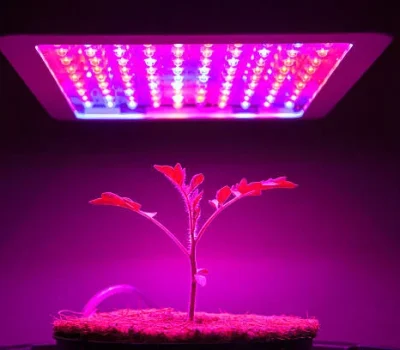

A full spectrum LED grow light is a white LED fixture that gives plants light across the whole range they use for photosynthesis, roughly 400 to 700 nanometres (nm), the same band of colours found in natural sunlight. Most modern fixtures add extra deep red light at 660 nm, and some extend into far red and UV A as well. The term itself has no legal or industry standard, so the only reliable evidence is the spectral chart and the measured light output.
This guide from Hydro Land explains what full spectrum LED means, how a white LED produces its light, what each of the five wavelength bands does for plants, how full spectrum light is measured, how it compares with red and blue LEDs, which spectrum suits each growth stage, how to check whether a grow light is genuinely full spectrum, and why light intensity matters even more than spectrum.
In short
- What it is: white light covering 400 to 700 nm, often with added 660 nm deep red, far red and UV A.
- Why it matters: one light covers every growth stage and shows plants in their true colours.
- What to check: the spectral chart, PPF and efficiency in µmol/J, not the words on the box.
What Is a Full Spectrum LED Grow Light?
A full spectrum LED grow light produces white light that covers every colour plants use for photosynthesis, from blue at about 400 nm to red at about 700 nm. This range is called PAR, or photosynthetically active radiation. Many current fixtures go a little further at each end, adding UV A below 400 nm and far red up to about 750 nm, so their output stretches across roughly 380 to 780 nm. In everyday terms, full spectrum means the light looks white and contains a continuous spread of wavelengths, rather than a few narrow colours.
That sets it apart from two other kinds of light. Older red and blue LED panels, often called “blurple” because of their purple glow, emit only narrow peaks of red and blue. A household bulb sold as “full spectrum” does produce a broad spectrum close to daylight, but at a small fraction of the output plants need, so it is not a grow light. A full spectrum grow light combines the broad, sunlight style spectrum with the intensity of a horticultural fixture.
Why Is “Full Spectrum” Not a Standard?
Full spectrum is a marketing description rather than a standard, so two lights with the same label can have very different spectra and output. No UK, EU or industry body defines which wavelengths a light must include to use the term. Makers apply it to everything from high output white fixtures with added deep red to cheap panels that mix a few white diodes with red and blue ones. You may also see the same idea called broad spectrum, sunlight spectrum or simply white LED grow light. The published spectral chart and the measured PPF are the only reliable evidence of what a light actually produces.
How Does a Full Spectrum LED Make White Light?
A full spectrum LED makes white light by coating a blue diode with phosphor, which converts part of the blue light into green, yellow and red. The process works in three stages:
- A blue diode emits light at about 450 nm. This is the most efficient kind of LED chip made.
- A phosphor coating converts part of that blue light. The phosphor glows across green, yellow and red, and the mix of the remaining blue and the converted light looks white.
- Grow light makers add extra diodes. Most add deep red diodes at 660 nm, and some add far red diodes at about 730 nm and UV A diodes at about 385 nm.
This combination explains why modern white fixtures are so efficient. Blue diodes and 660 nm red diodes convert electricity into light better than any other colour, so a good white fixture reaches 2.7 to 3.1 µmol/J, against about 1.7 µmol/J for a 600W HPS lamp. Premium fixtures use high grade chips such as Samsung LM301H EVO white diodes alongside Osram deep red diodes. For a wider look at the technology, read our guide on how a grow light bulb works.
What Do the 5 Wavelength Bands Do for Plants?
The five wavelength bands in a full spectrum grow light each influence how a plant grows, and they are summarised below from the shortest wavelength to the longest.
| Band | Range | Main effect on plants | Source in a grow light |
|---|---|---|---|
| UV A | 315 to 400 nm | Mild stress signal, more protective compounds | Added UV A diodes or a UV bar |
| Blue | 400 to 500 nm | Compact, sturdy growth | The blue diode under the phosphor |
| Green | 500 to 600 nm | Light deeper into the canopy | The phosphor coating |
| Red | 600 to 700 nm | Efficient photosynthesis, flowering | The phosphor plus 660 nm diodes |
| Far red | 700 to 750 nm | Stretch, leaf expansion, faster flowering | Added 730 nm diodes or a far red bar |
UV A Light (315 to 400 nm): Stress Response and Plant Compounds
UV A light is a small, invisible part of sunlight that plants treat as a mild stress signal, which can raise the level of protective compounds in leaves and flowers. Plants sense it through the UVR8 and cryptochrome photoreceptors. In response they produce more pigments and aromatic compounds and grow slightly thicker leaves. UV A is useful in small amounts, mostly late in flowering, and too much slows growth. UV C is a different matter altogether, used for sanitation rather than growing.
- In a grow light: added UV A diodes at about 385 nm, or a separate UV bar switched on for part of the day.
- Example: the Lumatek 30W UV Supplemental LED Bar delivers 12,000 mW of UV A plus 100 mW of UV B. Our guide to adding UV light to your grow covers timing and safety.
Blue Light (400 to 500 nm): Compact, Sturdy Growth
Blue light keeps plants short and compact, with thick leaves and close spacing between nodes, which is why seedlings and vegetative plants do well under cooler white light. Blue is detected by the cryptochrome and phototropin photoreceptors, which also control how leaves turn towards the light and how stomata open. Too little blue and plants stretch; a very high share of blue slows growth slightly. A typical white grow light delivers about 10 to 20% of its output as blue light, more in cool white and less in warm white.
- In a grow light: the blue diode under the phosphor, around 440 to 450 nm. Cool white diodes of 5000 to 6500K carry more blue.
- Example: the Secret Jardin Cosmorrow 6500K “Growing” bar, made for seedlings, cuttings and vegetative growth.
Green Light (500 to 600 nm): Light Deeper into the Canopy
Green light reaches deeper into a dense canopy than blue or red, so lower leaves keep photosynthesising, even though plants reflect more green than any other colour. Leaves still absorb most of the green light that reaches them, which corrects the old idea that plants cannot use green at all. Because green passes through the upper leaves more easily, it spreads photosynthesis through the whole plant rather than concentrating it at the top. Green light also lets you see the true colour of leaves under the lamp.
- In a grow light: the phosphor coating in every white diode.
- Example: any white full spectrum fixture, which is why the canopy looks natural under it.
Red Light (600 to 700 nm): The Engine of Photosynthesis
Red light drives photosynthesis more efficiently than any other colour, and deep red diodes at 660 nm are the main reason modern LEDs make so much light per watt. Chlorophyll absorbs red light strongly, and the phytochrome photoreceptor uses red light to judge day length and trigger flowering in many plants. A warmer spectrum with more red supports flowering and fruiting, which is why most fixtures pair warm white diodes with extra 660 nm red.
- In a grow light: red from the phosphor plus dedicated 660 nm deep red diodes.
- Example: the Secret Jardin Cosmorrow 60W “Blooming” bar, which is mostly warm 2700K white with added 660 nm deep red for the flowering phase.
Far Red Light (700 to 750 nm): Stretch and Faster Flowering
Far red light sits just beyond what the human eye can see, and it makes plants stretch and can speed up flowering, especially when given at the end of the day. Phytochrome reads the balance of red and far red, so extra far red signals shade and encourages longer stems and larger leaves. Far red also boosts photosynthesis when combined with shorter wavelengths, known as the Emerson effect. Research at Utah State University showed this so clearly that far red up to 750 nm is now included in an extended measure called ePAR.
- In a grow light: added 730 nm diodes, or a separate far red bar.
- Example: the Lumatek Zeus 600W Pro 3.1, listed with full spectrum output including far red and UV. For adding far red or UV to an existing setup, see our supplemental and under canopy lights.
How Is Full Spectrum Light Measured?
Full spectrum light for plants is measured in photons rather than lumens, because lumens count only the light the human eye sees best, which is mostly green and yellow. Five measurements describe a grow light properly:
- PAR: the 400 to 700 nm band plants use for photosynthesis.
- ePAR: the extended band of 400 to 750 nm that also counts far red.
- PPF: the total light a fixture produces in that band, in µmol/s.
- PPFD: the light landing on each square metre of canopy, in µmol/m²/s.
- Efficiency: how much light the fixture makes per unit of electricity, in µmol/J.
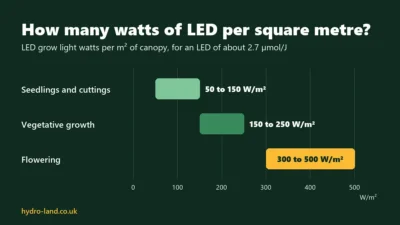
A lumen or lux figure on a grow light tells you how bright it looks to you, not how well it grows plants. To turn these numbers into a light size for your space, see how many watts of LED per square metre each tent needs.
What Does Colour Temperature in Kelvin Tell You?
Colour temperature in Kelvin (K) describes how warm or cool a white light looks, from a reddish 2700K to a bluish 6500K. Warm white of 2700 to 3000K carries more red, neutral white sits around 4000K, and cool white of 5000 to 6500K carries more blue. So 6000K looks whiter and bluer than 4000K, which looks slightly creamier. Colour temperature is a useful shortcut to a light’s balance of blue and red, though it does not measure output. The Secret Jardin Cosmorrow range shows the difference clearly: the 6500K “Growing” bars suit seedlings and veg, while the warm white “Blooming” bar with 660 nm red suits flowering.
What Does CRI Mean on a Grow Light?
CRI, the colour rendering index, measures how naturally colours look under a light on a scale of 0 to 100. Good white grow lights score 80 to 90 or more, so leaves, pests and early signs of deficiency look as they would in daylight. CRI does not measure growth, but a high CRI makes a grow room far easier to manage than the purple glow of a red and blue panel.
Full Spectrum vs Red and Blue LEDs: Which Is Better?
White full spectrum LEDs are better than red and blue LEDs for most growers, because they grow plants at least as well, show leaves in their true colours and are easier on the eyes. The main differences are compared below.
| White full spectrum LED | Red and blue LED (“blurple”) | |
|---|---|---|
| Light colour | White, warm or cool | Purple or pink |
| Spectrum | Continuous 400 to 700 nm, often plus 660 nm red, far red and UV A | Narrow peaks around 450 nm and 660 nm |
| Efficiency | 2.3 to 3.1 µmol/J on current fixtures | Similar on the best panels, lower on older ones |
| Growth | Every stage | Every stage at the same intensity |
| Seeing your plants | True colours, easy to spot pests and deficiencies | Leaves look dark or purple |
| Comfort for your eyes | Bright but natural | Tiring, hard to judge colour |
Red and blue panels made sense when white diodes were inefficient, because they concentrated output in the colours chlorophyll absorbs most strongly. White diodes have since caught up, and adding 660 nm red to a white base now gives the same efficiency with a far more useful light. Both types are well ahead of the orange glow of high pressure sodium, which manages about 1.7 µmol/J, as our comparison of LED vs HPS running costs shows.
Which Spectrum Suits Each Growth Stage?
Each growth stage benefits from a slightly different mix of light, from cooler, bluer white for seedlings to warmer, redder light for flowering. The best spectrum for each stage is listed below.
- Seedlings and cuttings: cool white of 5000 to 6500K at low intensity, which keeps young plants compact. Low power propagation lights are designed for this stage, and the same lights keep houseplants growing through a dark UK winter.
- Vegetative growth: neutral to cool white with a good share of blue, which builds sturdy stems and close node spacing.
- Flowering: warm white of 3000 to 3500K with added 660 nm red, plus optional far red at the end of the day and UV A in the last weeks.
In practice, most growers run one full spectrum fixture from seed to harvest and change the intensity rather than the spectrum, dimming the light for young plants and running it at full power in flower. A full spectrum supplemental bar, such as the Lumatek 100W bar, adds light to the edges of a tent or under the canopy without changing the main fixture.
How to Check If a Grow Light Is Really Full Spectrum
A grow light is really full spectrum when the maker publishes a spectral chart showing a smooth curve from about 400 to 700 nm with no large gaps. Five checks separate a genuine fixture from a label:
- Look for a spectral chart. A reputable maker publishes the spectral distribution of the light. A broad, continuous curve means a true white spectrum, while a few tall spikes with little between them means a red and blue light with a white name.
- Check the colour temperature and the added red. A listing that names the Kelvin of the white diodes and the 660 nm red diodes tells you the balance of the light.
- Compare PPF and µmol/J, not “equivalent watts”. PPF shows how much light the fixture makes, and µmol/J shows how efficiently. An “equivalent” wattage figure shows neither.
- Read the PPFD map. A grid of readings across the footprint shows whether the light reaches the corners of the tent as well as the centre.
- Look at the light itself. A genuine full spectrum grow light looks white with a slight warm or cool tint. A purple or pink glow means a red and blue light, whatever the box says.
Every light in our range of full spectrum LED grow lights lists its wattage and, where the maker provides them, its PPF and efficiency, so you can compare full spectrum LED grow lights in the UK on the numbers that matter.
Does Spectrum Matter More Than Light Intensity?
No, light intensity and efficiency matter more for yield than small differences in spectrum, as long as the light is a broad white spectrum. Research led by Bruce Bugbee at Utah State University has repeatedly found that, at the high light levels used in a grow tent, yield follows the amount of light reaching the canopy far more closely than the exact mix of colours. A 2021 study from the same group concluded that fixture efficacy and purchase price matter more for return on investment than spectral distribution when light levels are high.
Spectrum still changes the shape of a plant. More blue keeps plants compact, far red makes them stretch and can speed up flowering, and UV A raises protective compounds. These effects are real but secondary. The practical rule is to choose a white full spectrum light with the highest µmol/J and the right PPF for your space, then fine tune with far red or UV if you want to. Our guide to the best LED grow lights applies that rule to specific models.
Are Full Spectrum LED Grow Lights Worth It?
Yes, full spectrum LED grow lights are worth it for almost every indoor grower, because one light covers every growth stage while showing plants in their true colours. They are good for plants for four clear reasons:
- Every stage: one fixture grows seedlings, vegetative plants and flowering plants, with a dimmer doing the rest.
- True colours: pests, deficiencies and ripeness are easy to see under white light.
- High efficiency: the best fixtures reach 2.7 to 3.1 µmol/J, the most light per watt of any grow light.
- Lower heat: an LED adds about a quarter to a third less heat to a tent than HPS for the same light.
Buy on PPF and µmol/J first and on spectrum second, and any well made full spectrum grow light will grow healthy plants.
Is a Full Spectrum Light the Same as a Grow Light?
No, a full spectrum household bulb is not a grow light, because it produces a broad spectrum at a fraction of the light output plants need. A 10W “full spectrum” bulb is designed to light a room with natural looking colour, while a grow light is built and rated in PPF to drive photosynthesis. Our article on grow light vs regular LED explains where the line falls.
Do Full Spectrum LEDs Have UV?
Most full spectrum LEDs have no UV, because white LEDs start from a blue diode at about 450 nm and the phosphor only shifts light to longer wavelengths. Only fixtures with added UV A diodes, such as the Lumatek Zeus 600W Pro 3.1, or a separate UV bar produce ultraviolet light. UV B, which is shorter again, needs a dedicated bar.
Do Full Spectrum LED Grow Lights Use a Lot of Electricity?
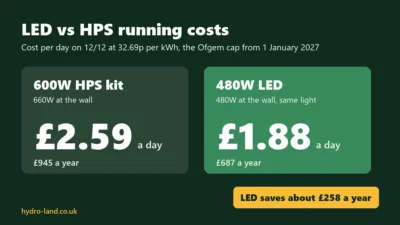
No, a full spectrum LED uses less electricity than any other type of grow light for the same amount of light. A 480W LED on a 12 hour day uses 5.76 kWh, which costs about £1.88 at the January 2027 UK price cap of 32.69p per kWh, compared with about £2.59 for a 600W HPS kit producing the same light.
Are Full Spectrum LEDs Good for Houseplants and Seedlings?
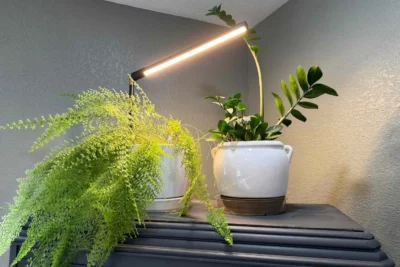
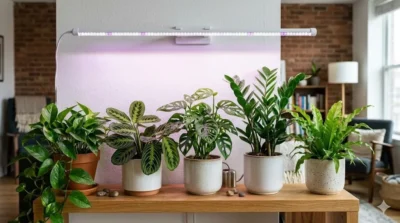
Yes, full spectrum LEDs are good for houseplants and seedlings, and a 20 to 60W white bar hung 15 to 30cm above the leaves is enough for most. Run it for 12 to 16 hours a day to make up for short days in a UK winter. The 40W Secret Jardin Cosmorrow COP bar, at 2.85 µmol/J, is a good example. For placement and timings, see our guide to grow lights for indoor plants.
Can You Use a Full Spectrum LED for Flowering?
Yes, a full spectrum LED with warm white diodes and added 660 nm red is the standard light for flowering plants today. Run it at 700 to 1,000 µmol/m²/s at the canopy on a 12 hour day, and add far red at the end of the day if you want to speed up flowering.
Is Full Spectrum Light Bad for Your Eyes?
No, full spectrum light is not bad for your eyes in normal use, but a grow light is bright enough that you never look straight into it. Dim the light or wear grow room glasses when working close to it for long periods, and always wear UV rated glasses when a UV bar is switched on.
Can You Get Vitamin D from a Full Spectrum Light?
No, a full spectrum LED does not give you vitamin D, because the skin needs UV B light between 280 and 315 nm to make it and white LEDs produce none. A grow light is designed for plants, not for people.
Hydroland Team
Hydroland is a horticulture and hydroponics supplier based in Manchester, delivering across the UK. Our team of horticulture specialists offers personalised guidance on hydroponic and soil growing, and we stock professional grade growing equipment for beginners and experienced growers alike.
Ready to light your grow?
Compare LED, CDM and HPS grow lights for every tent size. UK orders over £75 ship free.
Shop grow lights