

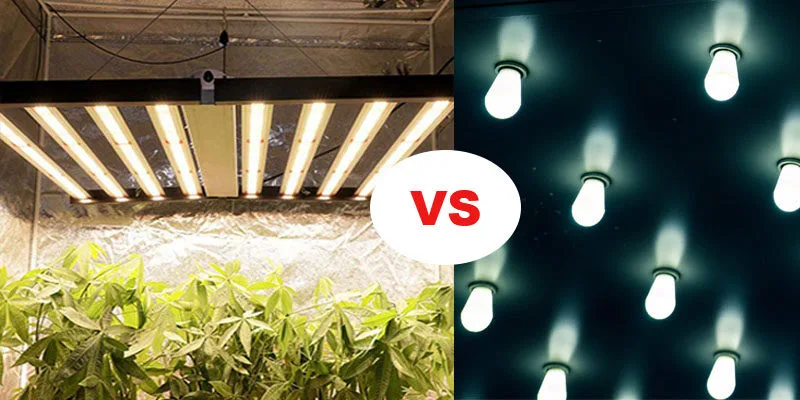
A regular LED light cannot replace a dedicated grow light for serious plant growth. Regular LEDs lack the red and blue wavelength concentration plants use for photosynthesis, and their light intensity drops below usable levels at typical growing distance. Low-light houseplants tolerate regular LED light short-term, but flowering and fruiting crops need a dedicated grow light’s spectrum and PPFD output to develop properly.
Key Takeaways
- Grow lights concentrate output in red and blue wavelengths, while regular LEDs spread output evenly across the visible spectrum for human vision.
- Lumens measure brightness as perceived by human eyes, not the light intensity plants actually use for photosynthesis.
- Red light drives flowering and fruiting, while blue light drives leaf and stem development during vegetative growth.
- Regular LEDs work for low-light houseplants but fail to sustain flowering or fruiting crops long-term.
What’s the Difference Between a Grow Light and a Regular Light?
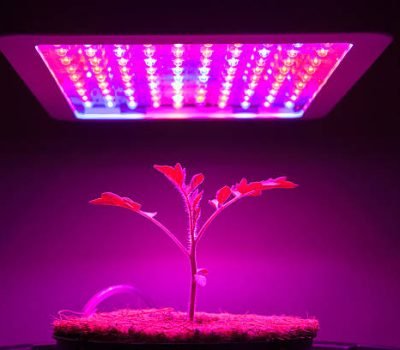
A grow light is an LED fixture engineered to emit concentrated red and blue wavelengths, the specific light bands plants use for photosynthesis. A regular light is an LED fixture engineered to emit a broad, even spectrum across all visible wavelengths, optimized for human eyesight rather than plant biology. This engineering difference determines how much usable light energy reaches a plant, regardless of how bright either light appears to a human observer.
Light Spectrum Comparison: Grow Lights vs Regular LEDs
Grow lights emit 60-70% of their output in red wavelengths (620-700nm) and blue wavelengths (400-500nm) combined, the two bands chlorophyll absorbs most efficiently. Regular LEDs emit output evenly across the 400-700nm visible range, including green and yellow wavelengths that plants reflect rather than absorb. This spectrum difference means a plant under a regular LED receives less usable light energy than the same wattage delivered through a grow light’s concentrated red-blue output.
Red Light Benefits for Plants
Red light triggers flowering and fruiting in mature plants by activating phytochrome, a photoreceptor protein that regulates a plant’s growth-stage transitions. Red light also drives stem elongation and overall biomass accumulation during active growth phases. Grow lights weight their spectrum toward red output during flowering stages specifically to maximize this phytochrome response.
Blue Light Benefits for Plants
Blue light drives compact, dense vegetative growth by activating cryptochrome, a separate photoreceptor protein that regulates leaf development and stem thickness. Plants grown under insufficient blue light stretch upward with thin stems and wide leaf spacing, a pattern called legginess. Grow lights weight their spectrum toward blue output during vegetative stages specifically to prevent this stretching and produce compact, sturdy growth.
Light Intensity: Understanding PPFD (Not Lumens)
PPFD, or Photosynthetic Photon Flux Density, measures the number of usable light particles reaching a plant’s leaf surface per square metre per second. This measurement matters more than lumens for grow light selection, since lumens measure brightness as human eyes perceive it, not the specific light plants use for photosynthesis.
What Is PPFD and Why Lumens Don’t Apply to Plants
PPFD counts photosynthetically active radiation, the 400-700nm light band plants convert into chemical energy, expressed as micromoles per square metre per second (μmol/m²/s). Lumens weight green and yellow wavelengths heavily, since human eyes perceive those colours as brightest, while plants absorb green and yellow poorly and use red and blue far more efficiently. A light rated at 1000 lumens can deliver dramatically different PPFD values depending on its spectrum, making lumens an unreliable metric for predicting plant growth outcomes.
PPFD Levels Needed by Growth Stage
Seedlings and clones need 100-300 μmol/m²/s to support early root and leaf development without light stress. Vegetative-stage plants need 400-600 μmol/m²/s to drive steady leaf and stem growth. Flowering-stage plants need 600-900 μmol/m²/s, the highest requirement of any stage, to support the energy-intensive process of bud and fruit development. Regular LEDs rarely exceed 100-200 μmol/m²/s at typical growing distance, falling short of even the seedling-stage requirement in most cases.
Can You Use a Regular LED Light as a Grow Light?
A regular LED light can sustain a low-light houseplant but cannot support flowering or fruiting crops, a limitation that comes from two combined factors: insufficient light intensity at growing distance and a spectrum weighted toward wavelengths plants don’t use efficiently.
Why Regular LEDs Fall Short for Serious Growth
Regular LEDs deliver most of their output in green and yellow wavelengths, light plants reflect rather than absorb for photosynthesis, which means a regular LED needs significantly higher total wattage than a grow light to deliver the same usable light energy. That intensity gap widens further with distance, since household fixtures aren’t designed to project usable light across a growing canopy the way a grow light’s optics and positioning are. Flowering and fruiting crops need sustained red-wavelength intensity as a result, a level a regular LED can’t consistently deliver at any practical distance.
When a Regular LED Might Work (Low-Light Houseplants Only)
Low-light houseplants like pothos, snake plants, and ZZ plants tolerate minimal photosynthetic activity, since these species evolved under low-canopy forest floor conditions and adapted to function on a fraction of the light intensity flowering or fruiting crops require. A regular LED positioned close to one of these plants sustains its existing growth, but stops short of driving the flowering or fruiting response a dedicated grow light produces in crops bred for higher light demand.
Can You “Hack” a Regular LED to Work as a Grow Light?
Hacking a regular LED into a functional grow light works only within narrow limits, and even then delivers weaker results than a purpose-built fixture at similar cost.
DIY Grow Light Conversions — What Actually Works
Stacking multiple regular LED fixtures close together increases total light intensity reaching a plant, partially offsetting the lower output any single regular LED delivers, while positioning several bulbs at different angles around that plant reduces shadowing and improves coverage compared to a single overhead fixture. Choosing bulbs labeled “daylight” or “cool white,” which run closer to 5000-6500K colour temperature, shifts output slightly toward the blue wavelengths plants use, compared to “warm white” bulbs that concentrate output in yellow and orange ranges plants use poorly. These adjustments improve a regular LED setup’s usefulness for low-light houseplants, but none of them add the red-wavelength concentration a flowering or fruiting crop actually needs.
Why This Rarely Saves Money Long-Term
Multiple stacked regular LED fixtures consume more combined electricity than a single grow light delivering equivalent usable output, since regular LEDs waste a larger share of their energy on wavelengths plants don’t absorb, and that higher running cost accumulates over a full grow cycle until it often exceeds what a dedicated grow light would have cost to buy outright. A hacked regular LED setup still fails to produce flowering or fruiting results regardless of electricity spent, which turns that ongoing cost into a loss rather than a saving once measured against actual harvest outcome.
Energy Efficiency and Heat: Grow Lights vs Regular LEDs
Grow lights convert a higher share of electrical input into usable plant light than regular LEDs, making them more energy-efficient for growing despite similar wattage ratings.
Energy Consumption Patterns
A 100W grow light running 16 hours daily costs roughly £8-£15 per month in the UK at current electricity rates, delivering that output concentrated in red and blue wavelengths plants use directly. A 100W regular LED costs the same to run but wastes a larger share of that output on green and yellow wavelengths plants reflect, delivering less usable light per pound spent on electricity. This efficiency gap means a grow light reaches target plant light intensity at a lower total wattage than a regular LED attempting the same result, narrowing the real running-cost difference between the two despite the grow light’s higher upfront price.
Heat Dissipation and Why It Matters for Plant Safety
Grow lights include heat sinks and fan-cooled designs engineered to dissipate heat away from the light source, keeping the fixture safe to run close to a plant canopy. Regular LEDs, designed for household fixtures with more ambient airflow, dissipate heat less efficiently at the close range a grow setup requires. This difference matters directly for plant safety, since a poorly cooled light positioned close enough to deliver usable intensity risks heat damage to nearby leaves, a risk grow lights are specifically engineered to avoid at their recommended hanging distance.
Lifespan and Durability: Grow Lights vs Regular Bulbs
Grow lights carry a rated lifespan of 50,000-100,000 hours, backed by driver and diode components built for continuous, close-range operation in humid grow room conditions. Regular LEDs carry a similar rated lifespan on paper, but their components aren’t built for the higher humidity and continuous runtime a grow tent demands, shortening their real-world lifespan under those conditions. Grow lights from established manufacturers typically include a 3-5 year warranty, reflecting the manufacturer’s confidence in components built specifically for grow room durability, while regular household LEDs rarely carry a warranty term suited to that same continuous, humid-environment use case.
How to Choose a Real Grow Light Instead
LED vs CDM vs HPS for Beginners
LED grow lights run cooler and use less electricity than CDM or HPS for equivalent light output, making them the standard beginner choice for a first small-tent setup. CDM lamps deliver a full spectrum with natural UV-A output, fitting into existing CDM fixtures without the driver and heat-sink complexity of an LED panel. HPS lights deliver strong light penetration for established, larger canopies, but run hotter and less efficiently than LED at equivalent output, making them better suited to experienced growers scaling beyond a beginner setup.
Budget Options That Still Deliver Real Results
A full-spectrum LED grow light for a small tent typically costs £100-£150 in the UK market*, delivering genuine PPFD output suited to seedling and vegetative growth without the compromised spectrum of a regular household LED. The Philips CDM Daylight 315W lamp costs £94.99-£99.95 and fits directly into an existing CDM fixture, giving budget-conscious growers a genuine full-spectrum option at a confirmed, comparable price point. Both options outperform a regular LED at a similar cost, since the spectrum and intensity difference covered earlier means a budget grow light still delivers usable plant light a regular LED can’t match regardless of price.
Common Mistakes Growers Make with Lighting
- Using household bulbs for flowering plants — a regular LED lacks the sustained red-wavelength intensity flowering requires, leaving plants stuck in vegetative growth with no bud development regardless of how long the light runs.
- Confusing wattage with actual light output — wattage measures electrical draw, not usable plant light, so a “1000W-equivalent” light drawing only 100W at the wall delivers far less intensity than the marketing figure suggests.
- Ignoring spectrum entirely and buying on price alone — a cheap light with the wrong spectrum wastes money twice, once on the purchase and again on electricity spent producing light the plant can’t use for photosynthesis.
FAQs
Can I use any LED light to grow plants?
Any LED light produces some usable light for plants, but not all LEDs produce enough. Regular household LEDs sustain low-light houseplants only, while flowering and fruiting crops need a dedicated grow light’s concentrated red-blue spectrum and higher PPFD output.
What’s the difference between lumens and PAR?
Lumens measure brightness as perceived by human eyes. PAR measures the specific 400-700nm wavelength range plants use for photosynthesis, making PAR the relevant metric for grow light output and lumens irrelevant to plant growth.
Can a regular LED grow a plant from seed to harvest?
A regular LED can support seed germination and early seedling growth, since young plants need minimal light intensity at that stage. Flowering and fruiting stages need a dedicated grow light’s red-wavelength concentration that a regular LED can’t sustain.
Is a full-spectrum LED the same as a grow light?
A full-spectrum LED marketed for plant growth is a grow light, engineered with red and blue wavelength concentration for photosynthesis. A full-spectrum LED marketed for household lighting is not a grow light, despite the similar terminology, since it’s engineered for human vision instead.
Will a regular LED work for herbs or houseplants?
A regular LED works for low-light herbs and houseplants positioned close to the light source. Herbs grown for dense leaf production or flowering still need a dedicated grow light’s higher intensity for consistent results.
How much does a real grow light cost compared to a regular bulb?
A dedicated grow light costs £95-£150 for a beginner setup, compared to £5-£15 for a regular household LED bulb. The grow light’s higher upfront cost delivers usable plant light a regular bulb can’t produce at any price point.
Do grow lights have to look industrial, or are there better-looking options?
Grow lights don’t have to look industrial. Several manufacturers now produce grow lights styled as pendant lamps or wall-mounted fixtures, blending plant-specific spectrum output with residential interior design.
Final Thoughts
A dedicated grow light earns its cost through spectrum and intensity a regular LED can’t replicate. Red and blue wavelength concentration drives the photosynthesis, flowering, and fruiting response covered throughout this guide, while a regular LED’s broad, human-optimized spectrum wastes output on wavelengths plants reflect rather than absorb. This gap explains why no amount of wattage or DIY adjustment closes the performance difference between the two light types.
Ready to light your grow properly? Browse Hydro-Land’s LED Grow Lights for a spectrum-matched fixture at any budget, explore CDM Grow Lights for a full-spectrum lamp with natural UV-A output, or browse the full Lighting range to compare every option side by side.