
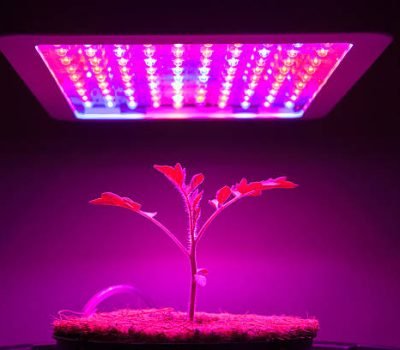
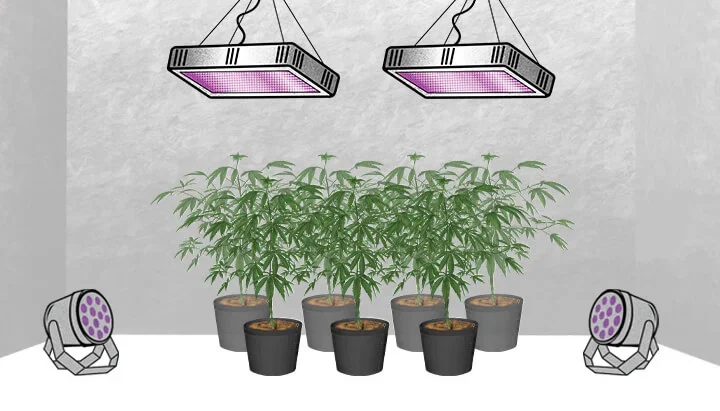
The best way to add UV light to a grow is a dedicated UV-A/UV-B LED bar mounted 12–18 inches above the canopy, run during the last two to three weeks of flower. Growers who want a simpler, single-fixture option choose a CDM/CMH lamp instead, since it emits usable UV-B without extra wiring or a second driver.
Key Takeaways
- UV-B light between 280–315nm triggers terpene and flavonoid production in the final two to three weeks of flower.
- CDM/CMH lamps deliver natural UV-B without extra hardware, while dedicated UV LED bars allow precise, adjustable output.
- Plants treat UV as a stress signal, not a growth nutrient, so exposure needs a gradual ramp-up schedule.
- UV-C light kills pathogens on surfaces and offers no benefit for plant supplementation.
What Is UV Light and Why Do Plants Respond to It?
Ultraviolet light is electromagnetic radiation with wavelengths shorter than visible light, spanning 100–400nm. Plants detect specific UV wavelengths through a photoreceptor protein called UVR8, which senses UV-B radiation and activates a defensive chemical response. This detection system evolved for survival in high-altitude and high-latitude environments, where UV intensity rises. Growers now replicate that same environmental trigger indoors.
UV as a Signal, Not Just Radiation
UV light functions as an environmental signal, not a direct energy source for photosynthesis. Chlorophyll absorbs red and blue light to drive photosynthesis, but UV wavelengths carry too little usable energy for that process. The UVR8 receptor instead reads UV-B exposure as a warning of intense sun conditions. This reading triggers production of protective compounds: flavonoids, anthocyanins, and aromatic terpenes. These compounds shield plant cells from UV-induced DNA damage, and this same defensive chain is what growers exploit for potency and aroma. Controlled UV-B exposure in late flower activates it on demand, concentrating the plant’s natural stress response into higher terpene output and stronger pest resistance.
UV-A vs UV-B vs UV-C: What Actually Matters for Growers
Ultraviolet light splits into three bands by wavelength, and each band produces a different effect on plants. Growers only need two of these bands for supplementation, since the third serves sanitation purposes exclusively.
UV-A (315–400nm)
UV-A light spans 315–400nm and sits closest to visible violet light. This proximity lets plants tolerate UV-A at higher intensities than UV-B, producing only mild, low-level stress. That mild stress still triggers anthocyanin production, deepening leaf and flower pigmentation, and supports modest terpene development, though at a lower magnitude than UV-B delivers. Many full-spectrum LED fixtures already include UV-A diodes as a baseline feature, since the wavelength’s low burn risk makes it safe for extended exposure.
UV-B (280–315nm)
UV-B light spans 280–315nm and drives the strongest defensive response of the three bands. This band activates the UVR8 photoreceptor directly, triggering flavonoid and terpene synthesis at a higher rate than UV-A achieves. The same activation thickens leaf trichomes, since trichomes function as the plant’s physical UV shield, and this thickening carries direct commercial value: higher trichome density raises resin content and visible bud quality. That value comes with a trade-off, though, since UV-B’s intensity demands more careful dosing than UV-A. Overexposure at this wavelength causes leaf bleaching and tissue damage within days.
UV-C — Why It’s for Sanitation, Not Supplementation
UV-C light spans 100–280nm and carries enough energy to break down DNA and RNA structures. That destructive power makes UV-C effective for surface sterilization, including grow room disinfection between cycles, but it offers no growth or potency benefit to living plants. Direct exposure instead damages plant tissue at the cellular level within minutes, which rules UV-C out for supplementation entirely. Growers apply it only to empty grow spaces, equipment, and water lines, never to plants during an active cultivation cycle.
The Real Benefits of Adding UV Light
UV light supplementation delivers three measurable benefits to indoor crops: increased aromatic compound production, stronger natural pest resistance, and a shift in the plant’s resource allocation between size and quality.
Terpene, Flavonoid & Aroma Development
UV-B exposure increases terpene concentration by triggering the plant’s defensive chemical pathway. Terpenes are aromatic oil compounds that give cannabis, hops, and many herbs their distinct scent profiles. Flavonoids develop alongside terpenes under UV stress, adding pigmentation and additional aromatic complexity. Growers running controlled UV-B supplementation during late flower report visibly denser trichome coverage and stronger terminal aroma at harvest. This aroma shift also affects flavor, since terpenes and flavonoids contribute directly to a crop’s taste profile.
Natural Pest & Disease Resistance
UV-B exposure strengthens a plant’s cuticle layer, the waxy outer coating on leaves and stems. A thicker cuticle blocks fungal spore penetration and reduces surface moisture retention, cutting the conditions that mold and mildew need to establish. UV light also disrupts the reproductive cycles of common pests, including spider mites and fungus gnats, since these organisms avoid high-UV environments. Growers use this resistance as a secondary line of defense alongside standard pest control products, not as a replacement for them.
The Trade-Off Nobody Talks About: Yield vs Potency
UV-B supplementation redirects plant energy from biomass production toward chemical defense compounds. This redirection means UV-treated plants often produce smaller overall yields than untreated plants under identical nutrient and light conditions. The energy a plant would otherwise spend on cell division and mass gain instead goes toward flavonoid and terpene synthesis. Growers chasing maximum weight per plant see this trade-off as a net loss, while growers prioritizing potency, aroma, and bud density see it as a worthwhile exchange. This trade-off explains why commercial operations targeting premium markets add UV-B late in flower, when yield gains have already plateaued and quality gains carry more market value.
How Much UV Do Plants Need? Dosage & Timing
UV dosage increases gradually across three growth phases: zero exposure in vegetative growth, low-intensity introduction at the start of flower, and full intensity during the final two to three weeks before harvest. This staged approach prevents the leaf bleaching and tissue stress that sudden full-intensity UV exposure causes.
A typical ramp-up schedule starts UV-B exposure at 2-3 hours daily during weeks one and two of flower, then increases to 4-6 hours daily by mid-flower. Full UV exposure of 8-12 hours daily applies only in the final two to three weeks, matching the plant’s main light photoperiod. The Lumatek 30W UV Supplemental LED Bar, for example, outputs 100mW of UV-B and 1200mW of UV-A per fixture, delivering 2.2 kJ of UV-B energy and 518 kJ of UV-A energy across a 12-hour cycle. This output level suits the full-intensity phase of the ramp-up schedule, not the introductory weeks.
When to Start (Veg vs Flower)
UV supplementation starts during flower, not during vegetative growth. Vegetative-stage plants prioritize leaf and stem development, and UV stress at this stage diverts energy away from that structural growth without producing usable resin or terpene gains. Flower-stage plants, by contrast, have already established their structural framework and shift naturally toward chemical compound production, making UV stress productive rather than wasteful. Growers introduce UV-B specifically at the flower stretch phase, roughly seven to ten days after switching the main light to a 12-hour photoperiod, then increase intensity toward the final two to three weeks before harvest.
Now the comparison table since this is Hydro-Land’s structural weapon against the competitors, let me confirm I have accurate specs for all four categories before building it.
I found solid data for two of the four categories but couldn’t confirm UV-specific specs or pricing for Faven/Aether under-canopy lights their listings describe general terpene and yield benefits, not confirmed UV-B/UV-A output. Rather than invent numbers for that row, I’ll flag it as “spectrum not confirmed” so nothing in the table is fabricated. Here’s what I can build with verified data:
Comparison Table: UV Grow Light Options at Hydro-Land
| Light Type | UV Output | Wattage | Best Use Case | Price |
|---|---|---|---|---|
| Philips CDM Lamp (Daylight 315W – 942 Elite Spectrum) | Natural UV-A output as part of full ceramic metal halide spectrum | 315W | All-in-one fixture upgrade, no extra wiring | £94.99 |
| Philips CDM Lamp (Daylight 315W – 930 Green Power Agro) | Natural UV-A output as part of full ceramic metal halide spectrum | 315W | Flower-stage spectrum with built-in UV component | £99.95 |
| Lumatek 30W UV Supplemental LED Bar | UV-B: 100mW (280–315nm) / UV-A: 1200mW (315–400nm) | 30W | Precise, adjustable UV dosing on Zeus-compatible fixtures | £189.99 |
| Under-Canopy Lighting (Faven/Aether) | Spectrum not confirmed as UV-specific — supports terpene and yield gains as full-spectrum supplementation | Varies by kit | Lower bud-site coverage alongside overhead UV | Varies |
Note: the Lumatek bar requires a separate power cable and is designed for Zeus-frame integration; the CDM lamps fit standard CDM/CMH fixtures already stocked in that category.
Best UV Grow Lights in 2026 — In-Depth Picks
Best All-in-One: Philips CDM Daylight 315W Lamp
The Philips CDM Daylight 315W lamp delivers a full ceramic metal halide spectrum with a natural UV-A component, priced at £94.99 for the 942 Elite Spectrum version and £99.95 for the 930 Green Power Agro version. Both fit standard CDM/CMH fixtures already common in UK grow rooms, so a single lamp swap adds UV exposure without installing a second driver or separate power cable. The 942 Elite Spectrum lamp suits vegetative and early-flower growth at 4200K, while the 930 Green Power Agro lamp shifts to flower-stage output at 3100K. Growers who want UV supplementation without extra wiring choose this lamp first, since the swap alone achieves the result.
Best Dedicated UV Bar: Lumatek 30W UV Supplemental LED Bar
The Lumatek 30W UV Supplemental LED Bar delivers 100mW of UV-B (280–315nm) and 1200mW of UV-A (315–400nm), priced at £189.99. That output translates to 2.2 kJ of UV-B energy and 518 kJ of UV-A energy across a 12-hour cycle, giving growers a measurable, controllable dose rather than an incidental byproduct of a full-spectrum lamp. The bar mounts directly onto Lumatek Zeus fixtures, and Lumatek recommends two units per fixture for even canopy coverage, with a separate power cable and daisy-chain cable required to run them. Growers running a Zeus LED system choose this bar over a CDM lamp specifically because intensity and spectrum ratio stay adjustable, independent of the main light source.
Best for Under-Canopy Coverage: Faven and Aether Under-Canopy Lighting
Faven and Aether under-canopy kits target the lower bud sites that overhead fixtures leave under-lit, improving flowering consistency and cutting the need for manual defoliation. Hydro-Land’s listings confirm terpene and yield gains from this spectrum supplementation, but stop short of publishing a specific UV-A or UV-B wavelength output. That gap means growers should treat this category as general spectrum support for lower canopy zones, not a confirmed UV source, and pair it with a dedicated UV-B fixture like the Lumatek bar whenever lower-canopy UV coverage is the actual goal.
How to Position and Run UV Lights in Your Grow Room
Distance from Canopy
UV LED bars mount 12 to 18 inches above the canopy, closer than a standard full-spectrum fixture. This distance balances UV intensity against burn risk, since UV wavelengths cause tissue damage faster than visible light at equal distance. CDM lamps run at the same distance as a standard CDM fixture, typically 18 to 24 inches, since their UV-A output sits within the lamp’s existing full-spectrum design and carries lower burn risk than a dedicated UV-B bar.
Daily Run-Time Guidance
UV run-time follows the ramp-up schedule from the dosage section: 2 to 3 hours daily during early flower, rising to 8 to 12 hours daily in the final two to three weeks. Growers running a CDM lamp skip this ramp-up entirely, since the lamp runs on the same photoperiod as the main light and delivers UV-A as a fixed proportion of total output. Growers running a dedicated UV-B bar control run-time independently through a timer or lighting controller, separate from the main fixture’s schedule.
Combining UV with Your Existing Spectrum
UV output supplements a full-spectrum light rather than replacing it, since plants still need red and blue wavelengths for photosynthesis. A UV-B bar pairs with any full-spectrum LED or HPS fixture already in place, running on its own timer during the ramp-up window. A CDM lamp with natural UV-A output replaces a single lamp in an existing CDM fixture, requiring no additional timer or wiring since the UV-A component runs on the same schedule as the rest of the spectrum.
Customising UV for Different Crops
Flowering/Fruiting Crops
Flowering and fruiting crops respond to UV-B with increased trichome density, deeper pigmentation, and stronger aromatic compound production. Tomatoes develop thicker cuticles and higher flavonoid content under UV-B exposure during fruit set. Cannabis and hop plants show the same pigmentation and resin response during late flower, which makes this crop category the primary target for UV supplementation in the sections above.
Leafy Greens & Microgreens
Leafy greens and microgreens respond to UV-A more than UV-B, since their shorter growth cycle limits the plant’s capacity to redirect energy into defensive compounds without stunting leaf development. Lettuce, basil, and kale increase anthocyanin production under low-intensity UV-A, deepening leaf colour and boosting antioxidant content without the biomass trade-off that UV-B causes in longer-cycle crops. Growers supplementing leafy greens use a lower UV intensity and shorter exposure window than flowering crops require.
Root Vegetables
Root vegetables show limited above-ground response to UV supplementation, since the harvestable portion of the plant develops underground, away from direct light exposure. Carrots, radishes, and beets gain minor leaf pigmentation under UV-A, but this has no measurable effect on root size, flavour, or nutrient content. Growers cultivating root vegetables generally skip UV supplementation, since the energy cost of running additional fixtures produces no corresponding yield or quality benefit for this crop category.
UV in Hydroponic, Coco & Soil Systems
UV supplementation works independently of the growing medium, since UV light affects the plant’s above-ground tissue rather than the root zone. Hydroponic systems deliver nutrients directly to the root zone at controlled concentrations, which lets plants redirect more available energy toward the flavonoid and terpene production that UV-B triggers. Coco coir systems buffer nutrient uptake slightly compared to hydroponics, producing a similar UV response but with marginally slower compound development. Soil-grown plants show the same UV-B response as hydroponic and coco systems, though soil’s natural microbial activity adds background stress that can compound with UV stress if nutrient levels run low. Growers using any of these three systems apply the same UV dosage schedule, since the variable that matters is light exposure, not root-zone chemistry.
Safety: Working Safely with UV Light
UV-B and UV-C exposure damages human skin and eyes at the same wavelengths that stress plant tissue, so grow room safety protocols apply directly to anyone entering the space during a UV cycle. Growers wear UV-rated safety glasses rated for 280–400nm blocking whenever installing, adjusting, or inspecting active UV fixtures, since brief unprotected exposure causes photokeratitis, a painful corneal burn. Full-length sleeves and gloves cover exposed skin during any hands-on work near an active UV-B bar, since skin exposure at close range for even a few minutes causes erythema, a UV-induced burn similar to sunburn.
Growers switch UV fixtures off before entering the grow room for extended tasks like trimming, watering, or plant inspection, then switch them back on after leaving. Ventilation systems already installed for heat and humidity control handle the additional heat load from a CDM lamp or UV LED bar without modification, though growers running multiple UV bars alongside a high-wattage main fixture should check total heat output against existing extraction capacity. A CDM lamp’s ballast generates more heat than an LED UV bar at equivalent UV output, so growers with limited extraction capacity choose the LED bar option specifically to avoid overloading their existing climate control setup.
Common UV Mistakes Growers Make
- Full-intensity UV-B from day one of flower : skips the ramp-up schedule entirely, causing immediate leaf bleaching and tissue damage since plants have no adaptive tolerance built up for high-intensity exposure.
- UV supplementation during vegetative growth : diverts energy away from structural development at a stage when the plant has no flowering compounds to produce yet.
- Mounting UV fixtures below the 12-inch minimum distance : produces the same bleaching seen with a skipped ramp-up, particularly with dedicated UV-B bars.
- Running UV fixtures on the main light’s fixed schedule : compounds overexposure risk, since UV-B needs a shorter, separately timed exposure window rather than a full photoperiod.
- Skipping PPE during hands-on grow room work : one of the most common safety mistakes, since growers underestimate how quickly UV-B damages skin and eyes at close range.
- Running UV-C fixtures on live plants : a more severe error, destroying plant tissue outright and signalling a basic misunderstanding of what each UV band does; UV-C belongs to empty-room sanitization only.
Buying Checklist: How to Choose the Right UV Light for Your Grow
Four factors decide which UV light fits a given setup: existing fixture compatibility, desired control precision, grow room heat capacity, and budget.
Fixture compatibility comes first, since it determines whether a lamp swap or a dedicated bar makes sense. Growers running a CDM/CMH fixture choose a UV-A CDM lamp, since it needs no additional wiring or mounting hardware, while growers running an LED system like Lumatek’s Zeus range choose a compatible UV LED bar instead, since a CDM lamp won’t fit an LED fixture at all.
Control precision follows directly from that choice. A dedicated UV-B bar runs on its own timer with adjustable run-time, letting growers follow the exact ramp-up schedule outlined earlier, whereas a CDM lamp’s UV-A output stays fixed to the main light’s schedule, offering no independent control.
Heat capacity narrows the choice further for growers with limited extraction. A CDM lamp’s ballast adds more heat load than an LED UV bar at equivalent UV output, so tight ventilation setups favour the LED option.
Budget settles the remaining decision. The Philips CDM Daylight 315W lamp costs £94.99 to £99.95 and replaces an existing lamp, making it the lower-cost entry point, while the Lumatek 30W UV Supplemental LED Bar costs £189.99 and requires additional cabling, making it the higher-cost, higher-precision option. The comparison table above weighs these four factors against a specific setup before purchase.
FAQs
Does UV really increase resin/potency, or just stress the plant?
UV-B exposure increases resin and potency through a genuine plant stress response, not a separate growth mechanism. The plant produces flavonoids and terpenes as a defensive reaction to UV-B, and that same defensive chain raises trichome density and aromatic compound concentration.
What’s the difference between UV-A and UV-B for grow rooms?
UV-A spans 315–400nm and produces mild pigmentation and modest terpene gains at low stress levels. UV-B spans 280–315nm and drives stronger trichome density, resin production, and terpene synthesis, but requires more careful dosing to avoid leaf damage.
Is UV light safe for people and pets in the room?
UV-B and UV-C exposure damages human skin and eyes at close range, so people should wear UV-rated glasses and covered clothing near active fixtures. Pets should stay out of the grow room entirely during UV cycles, since their eyes lack the same protective mechanisms.
Should UV be used in veg or only flowering?
UV supplementation applies during flowering, not vegetative growth. Vegetative plants prioritize structural development, and UV stress at that stage diverts energy away from growth without producing usable resin or terpene gains.
How much UV is too much?
UV-B exposure beyond 8-12 hours daily at full intensity causes visible leaf bleaching within days. Introducing full intensity without a ramp-up schedule produces the same damage even at shorter daily exposure.
Can I use a reptile/aquarium UV bulb instead of a grow-specific one?
Reptile and aquarium UV bulbs emit uncalibrated UV output not designed for plant dosing schedules, risking both underexposure and burn damage. Grow-specific UV fixtures publish exact UV-A and UV-B output in milliwatts, letting growers dose precisely.
How long should UV run each day?
UV run-time starts at 2-3 hours daily during early flower and increases to 8-12 hours daily during the final two to three weeks before harvest. CDM lamps with natural UV-A output run on the same schedule as the main light, requiring no separate timer.
What’s the fastest way to add UV to an existing setup?
A CDM lamp swap adds UV-A output fastest, since it replaces an existing lamp without new wiring. A dedicated UV-B bar takes longer to install but gives independent control over intensity and timing.
Final Thoughts
UV supplementation earns its place in a 2026 grow room for growers prioritizing potency, aroma, and bud quality over maximum yield weight. The trade-off between biomass and chemical compound production means UV isn’t a universal upgrade, but it delivers measurable results for flowering and fruiting crops during the final weeks before harvest.
Growers ready to add UV can browse Hydro-Land’s full Lighting range for CDM lamps and Lumatek UV bars, pair overhead UV with Under Canopy Lighting for full-plant coverage, and check Environment Control options to manage the added heat load from extra fixtures.