
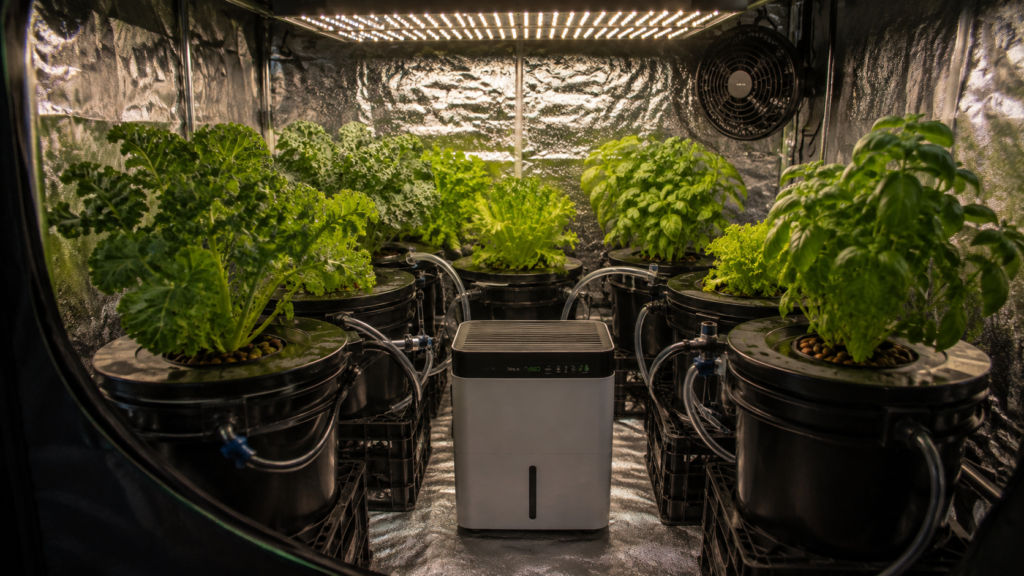
Lower grow tent humidity by increasing extraction, adding a dehumidifier sized to the tent’s volume, and removing excess water sources like overwatering or standing water in trays. Target 40-50% relative humidity during flower and 40-70% during vegetative growth, adjusting extraction and dehumidification to match each stage.
Key Takeaways
- High humidity in a grow tent stems from four main causes: overwatering, poor airflow, overcrowding, and external room humidity.
- Target humidity ranges shift by growth stage, dropping from 60-70% in seedling to 40-50% during flower.
- Extraction fan sizing matters more than dehumidifier purchase for most humidity problems, since undersized airflow is the root cause in the majority of cases.
- Sealing a tent too tightly to “trap” conditions backfires, since stagnant air raises both humidity and mould risk.
Why Is Humidity High in My Grow Tent? (Root Causes)
Grow tent humidity rises from one of four sources: excess water entering the space, insufficient air exchange removing moisture, too many plants transpiring at once, or high humidity in the surrounding room feeding the tent’s intake air. Identifying which source applies determines which fix actually solves the problem, rather than masking it temporarily.
Overwatering & Standing Water
Overwatering saturates growing medium beyond what roots can absorb, and that excess moisture evaporates directly into the tent’s air. Standing water in drip trays or saucers adds a second evaporation source, releasing moisture continuously even between watering sessions. Both sources raise humidity steadily over hours, not instantly, making them easy to overlook until condensation appears on tent walls.
Poor Airflow or Undersized Extraction
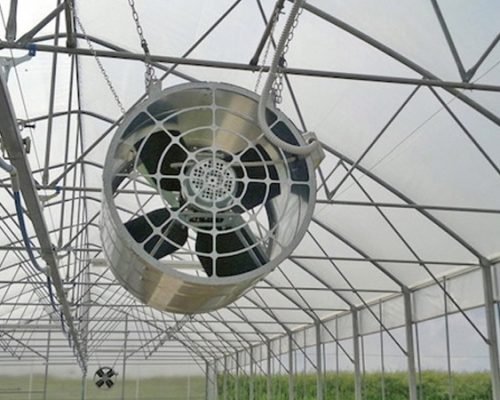
An extractor fan sized below the tent’s volume requirement fails to exchange air fast enough to remove moisture as plants transpire and soil evaporates. This undersizing lets humidity accumulate faster than the fan can extract it, even when the fan runs continuously. Poor internal airflow compounds the problem, since stagnant air pockets trap moisture near the canopy regardless of how much air the extraction system removes overall.
Too Many Plants in Too Small a Space
Each plant releases water vapour through its leaves during transpiration, and that vapour output scales with total leaf surface area in the tent. Overcrowded tents pack more leaf surface into the same air volume, raising total transpiration output beyond what a correctly sized extraction system for that tent alone can handle. This overcrowding effect explains why two tents of identical size can show different humidity levels, based purely on plant count and canopy density.
High External Room Humidity
A grow tent draws intake air from the surrounding room, so a humid room feeds humid air directly into the tent regardless of internal extraction capacity. Basements, bathrooms-adjacent spaces, and poorly ventilated rooms commonly run higher ambient humidity than the rest of a home. This external factor limits how low internal extraction alone can push tent humidity, since the incoming air already carries moisture before the tent’s own systems act on it.
What’s the Ideal Humidity Level for a Grow Tent?
Ideal grow tent humidity shifts across three growth stages, starting high for seedlings and dropping progressively through vegetative growth into flower. This downward pattern matches each stage’s changing risk profile, since young plants need moisture for root development while mature flowering plants need dryness to prevent bud rot.
Humidity by Growth Stage
| Growth Stage | Ideal Relative Humidity |
|---|---|
| Seedling / Clone | 60-70% |
| Vegetative | 40-70% |
| Early Flower | 40-50% |
| Late Flower | 30-40% |
Seedlings and clones need 60-70% humidity to support root development before their root systems mature enough to draw sufficient water on their own. Vegetative-stage plants tolerate a wider 40-70% range, since established roots handle moisture fluctuation better than seedlings. Early flower drops to 40-50%, reducing the moisture that bud rot pathogens need to establish. Late flower drops further to 30-40%, since dense, developing buds trap moisture internally and need the driest surrounding air of any stage to stay protected.
Signs Your Grow Tent Humidity Is Too High
Four signs indicate excess humidity in a grow tent: condensation on tent walls, slowed growth, visible bud rot or mould, and a rise in pest activity.
- Condensation on tent walls appears when moist air meets the tent’s cooler interior surface, signalling humidity levels the air can no longer hold as vapour.
- Slowed growth develops when plants can’t transpire effectively in overly humid air, since transpiration drives nutrient uptake and excess ambient moisture blocks that process.
- Bud rot or mould shows as discoloured, mushy patches inside dense flower clusters, or as white powdery patches on leaves, both signs that humidity has stayed above safe thresholds long enough for pathogens to establish.
- Pest increase follows high humidity closely, since fungus gnats and other moisture-loving pests breed faster in consistently damp growing medium and air.
Catching these signs early prevents the crop damage that follows once humidity-driven mould or pests take hold.
How to Lower Humidity Without a Dehumidifier
Five free or low-cost adjustments lower grow tent humidity before any equipment purchase becomes necessary: improving ventilation, adjusting watering habits, thinning plant density, pruning foliage, and managing heat output from the grow light.
Improve Ventilation & Exhaust Setup
Increasing extraction fan runtime removes moist air faster than the rate plants and soil add it back, lowering overall tent humidity without new equipment. Opening intake vents fully, rather than partially, lets fresh air replace extracted air at a matching rate, preventing the negative pressure buildup that restricts total airflow. Repositioning ducting to remove sharp bends improves airflow efficiency, since bent ducting reduces the effective extraction rate a fan can otherwise achieve.
Reduce Watering Frequency & Remove Standing Water
Reducing watering frequency limits the moisture available to evaporate into tent air between sessions, directly lowering the humidity overwatering causes. Removing standing water from drip trays immediately after each watering session eliminates a second evaporation source that otherwise raises humidity continuously. Watering in the morning, rather than evening, gives excess moisture more hours to evaporate and extract out during the day’s active light cycle.
Avoid Overcrowding Plants
Spacing plants further apart reduces total leaf surface density in a given tent volume, lowering the combined transpiration output that raises humidity. Removing or relocating excess plants brings transpiration output back within the extraction system’s effective capacity for that tent size. This spacing adjustment costs nothing and often resolves humidity problems that persist despite correctly sized extraction equipment.
Prune Excess Foliage
Pruning lower, shaded leaves reduces total transpiring leaf surface without removing the canopy’s primary light-receiving growth. This selective removal lowers humidity output the same way plant spacing does, but works within a single plant rather than across the whole tent. Pruning also improves internal airflow around the remaining canopy, reducing the stagnant air pockets where humidity concentrates near dense foliage.
Optimize Grow Light Heat Output
Increasing grow light heat output raises the air’s capacity to hold moisture as vapour before condensation occurs, which lowers relative humidity even when absolute moisture content stays the same. Growers achieve this by adjusting light height closer to the canopy within safe limits, or by switching to a light type that runs warmer, such as HPS over LED. This method works only within safe temperature ranges for the growth stage, since excess heat causes its own stress separate from humidity concerns.
How to Lower Humidity With a Dehumidifier
A dehumidifier removes moisture directly from tent air, working faster than ventilation alone in spaces where extraction can’t keep pace with humidity production. This makes a dehumidifier the correct addition when overwatering, overcrowding, and airflow adjustments still leave humidity above target range.
Choosing a Dehumidifier by Tent Size
Small tents up to 80x80cm need a compact dehumidifier rated for 10-20 litres of moisture removal per day, matching the lower total moisture output of a smaller plant count. Tents from 100x100cm to 120x120cm need a mid-capacity unit rated for 20-30 litres daily, accounting for higher plant density and greater transpiration output. Tents larger than 150x150cm need a 30-litre-plus unit, or multiple smaller units positioned at different points in the space, since a single undersized unit can’t remove moisture fast enough across that larger volume.
Where to Position a Dehumidifier in a Grow Tent
A dehumidifier positioned near the tent’s air intake removes moisture from incoming air before it reaches the canopy, reducing humidity at the source rather than after it spreads through the space. Elevating the unit above floor level improves air circulation around it, since floor-level placement restricts airflow into the unit’s intake. Keeping at least 15-20cm clearance around all sides of the unit maintains that circulation and prevents the unit from recirculating the same limited pocket of air repeatedly.
Sizing Your Extraction Fan to Control Humidity
Extraction fan size determines how fast a tent exchanges humid air for fresh air, making correct sizing the single most effective lever for humidity control before any other method applies.
Calculating Fan Size (m³/h) for Your Tent Volume
Fan size is calculated by multiplying tent volume in cubic metres by the number of air exchanges needed per hour. An 80x80x160cm tent has a volume of roughly 1 cubic metre, requiring a fan rated at 20-60 m³/h to exchange that volume every 1-3 minutes. A 100x100x200cm tent has a volume of roughly 2 cubic metres, requiring a fan rated at 40-120 m³/h for the same exchange rate. Adding a carbon filter to the extraction line reduces the fan’s effective output by roughly 25%, so growers select a fan rated above the calculated minimum to offset that filter-related resistance.
Advanced Humidity Control: VPD Controllers & Automation
Vapour Pressure Deficit, or VPD, measures the gap between the moisture the air holds and the maximum moisture it could hold at a given temperature. This single figure combines temperature and humidity into one number, giving growers a more accurate control target than humidity alone, since identical humidity readings can represent different actual plant stress levels depending on temperature.
A VPD controller reads both temperature and humidity in real time, then automatically adjusts connected extraction fans, dehumidifiers, and heaters to hold VPD within a target range for the current growth stage. This automation removes the manual guesswork of adjusting humidity and temperature separately, since the controller calculates the correct combined response and applies it without grower intervention. Systems like TrolMaster integrate multiple devices under one VPD target, letting a single controller manage extraction, dehumidification, and heating together rather than requiring separate manual adjustments for each device.
Growers running multiple tents or scaling beyond a single beginner setup benefit most from VPD automation, since manual monitoring across several spaces becomes time-consuming and error-prone at that scale. A single-tent beginner grow typically achieves adequate humidity control through the manual methods and correctly sized equipment covered above, making VPD automation a scaling tool rather than a beginner requirement.
What Happens If Humidity Stays Too High? (Risks)
Three specific risks develop when grow tent humidity stays elevated beyond safe thresholds for an extended period: bud rot, powdery mildew, and a root rot feedback loop.
Bud Rot (Botrytis)
Bud rot, caused by the fungus Botrytis cinerea, develops inside dense flower clusters where humidity stays trapped even when surrounding tent air reads within target range. This internal moisture pocket lets the fungus establish before any visible external sign appears, making bud rot especially dangerous since it often goes undetected until buds are opened or harvested. Affected buds turn brown, mushy, and develop a distinct musty smell, and any affected bud typically requires removal to prevent spread to surrounding, healthy flower sites.
Powdery Mildew
Powdery mildew appears as white, dusty patches across leaf surfaces, spreading fastest in humidity above 50-60% combined with poor airflow. Unlike bud rot, powdery mildew shows visible external symptoms early, giving growers a chance to intervene with airflow and humidity correction before the infection spreads to flowering sites. Left untreated, powdery mildew reduces photosynthetic leaf surface and can spread from foliage into developing buds, compounding into the same rot risk described above.
Root Rot Feedback Loop
Overwatering that raises tent humidity also saturates growing medium, creating low-oxygen conditions that let root-rot pathogens establish in the root zone. Root rot reduces a plant’s capacity to draw up water through its roots, which growers often misread as a sign the plant needs more water rather than less. That misread response leads to further overwatering, which raises humidity further and worsens the root rot it was meant to fix, creating a compounding cycle that’s difficult to reverse without addressing both the overwatering and the humidity it causes together.
Common Mistakes When Trying to Lower Humidity
- Sealing the tent too tightly — closing all vents to “trap” a controlled environment instead kills airflow entirely, letting humidity and heat build up faster than any equipment inside can correct.
- Running a dehumidifier without adequate extraction — a dehumidifier alone can’t compensate for undersized ventilation, since stagnant air around the canopy stays humid even as the unit removes moisture elsewhere in the tent.
- Overwatering — the most common root cause covered earlier persists as a top mistake here too, since growers often keep overwatering out of habit even after adding humidity-control equipment.
- Overcrowding plants — packing more plants into a tent than its extraction system supports keeps transpiration output above what any single fix, including a dehumidifier, can fully offset.
- Neglecting the basics before buying equipment — growers reach for a dehumidifier or VPD controller before fixing overwatering, undersized extraction, or overcrowding first, spending on equipment that treats a symptom while the actual cause keeps generating excess moisture.
Monitoring Humidity: Staying Ahead of the Problem
Consistent monitoring catches humidity problems before they reach the thresholds that cause bud rot, mildew, or root rot, turning a reactive fix into a preventable adjustment.
Daily Monitoring with a Thermo-Hygrometer
A thermo-hygrometer placed at canopy height gives the most accurate reading, since humidity near the tent floor or ceiling often differs from conditions directly around the plants. Checking readings at the same time each day builds a reliable pattern, letting growers spot gradual drift toward unsafe levels before it becomes a sudden spike. Logging daily readings, even briefly, reveals trends a single check can’t show, such as humidity climbing steadily across a flowering cycle as bud density increases.
Adjusting for Seasonal Changes
Ambient room humidity shifts with the seasons, rising in summer and during humid weather, and dropping in winter with indoor heating running. A dehumidifier that maintains target humidity in winter may fall short in summer, when incoming intake air already carries more moisture. Growers reassess extraction and dehumidification capacity each season, rather than assuming a setup calibrated once will hold steady through a full year of varying external conditions.
Quick-Fix Checklist: Lower Humidity Today
- Check for standing water in drip trays and remove it immediately.
- Increase extraction fan runtime or switch to continuous operation.
- Open intake vents fully to match increased extraction airflow.
- Reduce watering frequency until humidity drops back into target range.
- Thin out overcrowded plants or prune lower, shaded foliage.
- Add a dehumidifier sized to tent volume if manual fixes aren’t enough.
- Position the dehumidifier near the tent’s intake, elevated with clearance on all sides.
- Measure humidity at canopy height with a thermo-hygrometer to confirm improvement.
- Recheck the tent for tight seals and open any over-sealed vents.
FAQs
What humidity is too high for a grow tent?
Humidity above 50% during flower counts as too high for a grow tent. This threshold drops further to 40% during late flower, when dense buds trap internal moisture and need drier surrounding air.
Can I lower humidity without a dehumidifier?
Lowering humidity without a dehumidifier is possible through ventilation, watering adjustments, and plant spacing. Increasing extraction, reducing watering frequency, and thinning overcrowded plants often resolves humidity problems on their own.
Does more ventilation always lower humidity?
More ventilation lowers humidity only when external room air holds less moisture than the tent’s internal air. Ventilation in a humid room recirculates that moisture into the tent rather than removing it.
How do I stop bud rot from high humidity?
Stopping bud rot requires keeping humidity below 40% during flower and maintaining strong airflow around dense flower clusters. Removing any already-affected buds prevents Botrytis spread to surrounding healthy sites.
Is high humidity worse in veg or flower?
High humidity is worse in flower than in vegetative growth. Dense flower clusters trap moisture internally, creating conditions for bud rot that vegetative-stage foliage doesn’t face in the same way.
Why is my grow tent humidity high even with a fan running?
High humidity despite a running fan points to an undersized fan, a bent or restricted duct, or high ambient room humidity feeding the intake. Checking fan rating against tent volume identifies which cause applies.
Do moisture-absorbing products actually work?
Moisture-absorbing products remove a small amount of ambient moisture in enclosed spaces. Their capacity is limited compared to a dehumidifier or correctly sized extraction, making them a minor supplement rather than a primary fix.
What’s a VPD controller and do I need one?
A VPD controller automates temperature and humidity adjustment by targeting Vapour Pressure Deficit instead of humidity alone. Single-tent beginner grows rarely need one, since manual methods and correctly sized equipment achieve adequate control at that scale.
Conclusion
Humidity control starts with diagnosis, not equipment. Overwatering, undersized extraction, and overcrowding cause most humidity problems, and each one has a free or low-cost fix before a dehumidifier or VPD controller becomes necessary. Correctly sizing an extraction fan to tent volume resolves the majority of cases on its own, since airflow removes moisture faster than most other methods combined.
Growers who still see humidity above target range after addressing these root causes benefit from adding a dehumidifier sized to their tent, or a VPD controller for multi-tent setups scaling beyond manual monitoring. Ready to bring humidity under control? Browse Humidity Control for dehumidifiers sized to your tent, explore Full Climate Control for VPD automation, and pick up a thermo-hygrometer to monitor conditions daily.