

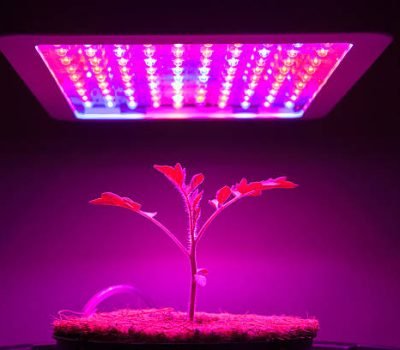
A plant grow light bulb is an artificial light source emitting 400 to 700 nm wavelengths, the photosynthetically active radiation (PAR) range, that supplements or replaces sunlight. Grow lamps, horticultural bulbs, and plant lights are its synonyms. Each converts electricity into light through a filament, gas discharge, or LED semiconductor. This guide explains that process, the blue and red spectrum plants use, five bulb types, and the specifications, including PPFD and DLI, that measure output.
What is a Plant Grow Light Bulb?
A plant grow light bulb is a light source that emits photosynthetically active radiation (PAR), the 400 to 700 nm band useful for plant growth. Singapore’s National Parks Board expresses plant-usable output as PPFD in µmol/m²/s, while lumens measure brightness as the human eye perceives it.
How a Grow Light Bulb Differs from a Regular Household Bulb
A grow light bulb differs from a regular household bulb by emitting light matched to plant absorption rather than human vision. Singapore’s National Parks Board reports that a fixture rich in blue and red light scores fewer lumens than a green and yellow one, so lumens misrate plant light. UConn Extension names PPFD as the metric for judging output at a set distance from the light.
Heat separates the bulb types further. According to Smart Garden Guide, incandescent bulbs emit heat in large proportion to light, and fluorescent bulbs stay cool but do not target plant wavelengths.
Ornamental foliage plants and blooming plants have different demands. Household LED bulbs carry red and blue wavelengths at lower intensity, which suffices for most ornamental indoor plants. University of Nebraska–Lincoln Extension notes that blooming plants require higher levels of red light, supplied by horticultural fluorescent lights or LED grow lights.
Grow Light Bulb vs. Grow Light Fixture
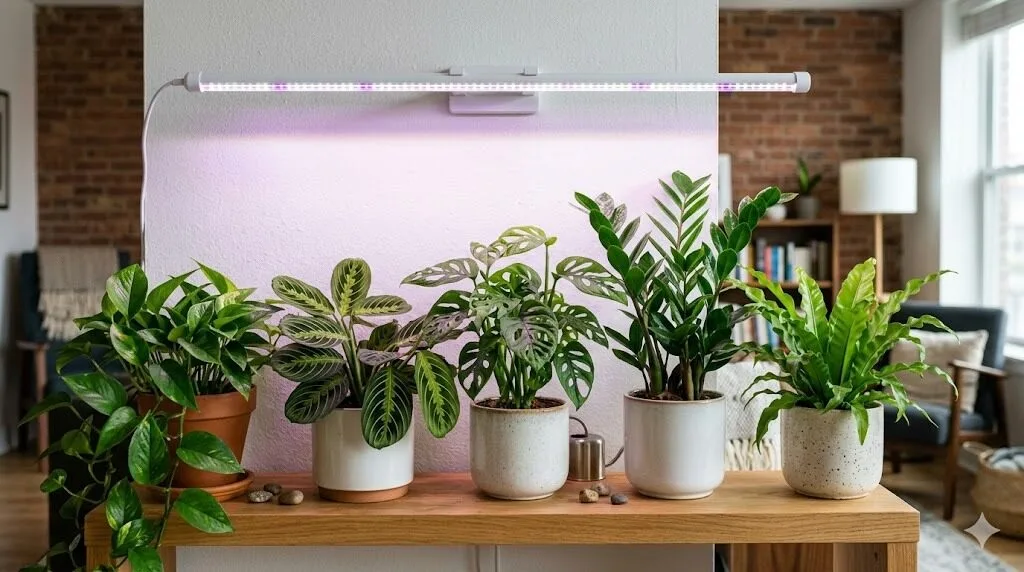
A grow light bulb is the replaceable light source, and a grow light fixture is the unit that holds it. The Daily Garden lists three setups: grow bulbs that screw into traditional lamps, stand-alone planters with built-in grow lights, and shop light hoods fitted with fluorescent grow lights.
Iowa State University Extension compares light sources on five factors: intensity, wavelength, purchase cost, efficiency, and heat produced. Replacing the bulb changes the spectrum, intensity, and heat output of an existing setup, if the socket fits
When Do Plants Need Artificial Light?
Plants need artificial light when indoor light limits growth, as in winter and during seed starting. Iowa State University Extension states that even the brightest windowsill holds only a fraction of outdoor light intensity, and winter lowers it further through short days, a low sun angle, and overcast skies.
The Kemper Center for Home Gardening lists four signs of insufficient light:
- Pale, yellow, or white leaf discoloration
- Stretched, leggy stems (etiolation)
- Excessive leaf drop
- Missing flower buds
Kemper Center adds that any plant grows under artificial light, and African violets, orchids, succulents, herbs, and seedlings most commonly need supplemental light in winter. For seed starters, Garden Professors report that supplemental light raises intensity and lengthens duration, even for plants in windows.
How Does a Plant Grow Light Bulb Work?
A plant grow light bulb works by converting electrical energy into light in the 400 to 700 nm PAR range, the range in which plant pigments absorb light. Intensity, duration, and distance set how much of that light reaches the plant.
How Plants Use Light for Photosynthesis
Plants use light for photosynthesis by absorbing photons with pigments that convert light energy into chemical energy, stored in glucose and other organic molecules. Raven Biology states that plant pigments absorb only 400 to 700 nm light.
Within that range, chlorophyll a absorbs blue-violet light, chlorophyll b absorbs red-blue light, and neither absorbs green, so leaves appear green. Carotenoids add blue-green and violet absorption.
What Is PAR and Why Does It Matter?
PAR is photosynthetically active radiation, the 400 to 700 nm wavelength range that plant pigments absorb. UConn Extension lists PAR as the ideal measurement for plant growth and lumens as a brightness unit.
Kelly, Meng, and Runkle define PPFD, the PAR metric, as the number of photons in the 400 to 700 nm range falling on one square meter each second, measured in µmol/m²/s.
How Different Bulbs Produce Light (Filament, Gas Discharge, LED Semiconductor)
Different bulbs produce light through three mechanisms: a heated filament, a gas discharge, or an LED semiconductor. IEEE TechNav describes each one:
- Filament bulbs heat a tungsten filament to about 2700 K, and more than 90 percent of the input energy leaves as heat.
- Discharge bulbs pass current through ionized gas or vapor, and fluorescent types convert 254 nm ultraviolet radiation into visible light through a phosphor coating.
- LED bulbs generate light through semiconductor electroluminescence, a process more efficient than thermal radiation or discharge.
Why Intensity, Duration, and Distance All Matter
Intensity, duration, and distance all matter because they set the daily light integral (DLI), the total light a plant receives in one day. Kelly, Meng, and Runkle define DLI as the product of PPFD and photoperiod.
- Intensity: in lettuce trials at DLIs of 15 and 20 mol/m²/day, photosystem II efficiency fell from 0.67 to 0.28 as PPFD rose from 189 to 794 µmol/m²/s.
- Duration: a 2023 Scientific Reports study gave lettuce photoperiods of 12, 16, and 20 hours at 200 µmol/m²/s, producing DLIs of 8.64, 11.5, and 14.4 mol/m²/day, and fresh weight rose to 393 g at 11.5 before the 14.4 DLI reduced it.
- Distance: under the inverse-square law, a plant twice as far from the bulb receives one quarter of the light, so distance changes PPFD at the leaf.
What Light Spectrum and Color Do Plants Need?
Plants need light across the 400 to 700 nm PAR range, divided into blue (400 to 500 nm), green (500 to 600 nm), and red (600 to 700 nm) wavebands. Michigan State University Extension specialist Erik Runkle reports that spectrum effects are strongest when LEDs are the only light source, and weaker when lighting supplements sunlight.
Blue Light for Vegetative Growth
Blue light supports vegetative growth by inhibiting extension growth, which produces smaller leaves and shorter stems. Runkle reports that chlorophyll absorbs blue light strongly for photosynthesis. His PLOS ONE study adds that growers add blue radiation to red for normal photosynthetic function and desired plant form.
Red Light for Flowering and Fruiting
Red light regulates flowering through phytochrome, a pigment that absorbs red and far-red radiation. Runkle reports that red light delivered at night prevents flowering in short-day plants.
Red is also the most efficient waveband for photosynthesis, according to Runkle’s PLOS ONE study. Most LED arrays emit 75 to 90 percent red light, because chlorophyll absorbs it well and red LEDs convert electricity efficiently.
Is Green Light Useful to Plants?
Green light is useful to plants: leaves absorb 70 to 80% of it, and it penetrates deeper into leaves and canopies than blue or red light. Meng and Runkle report this in Produce Grower.
Runkle adds that green light is generally less efficient than blue or red at stimulating photosynthesis, because chlorophyll absorbs it poorly. For growers, green light also restores natural plant color, since blue-plus-red LED arrays make visual assessment of plants difficult.
Full-Spectrum vs. Targeted-Spectrum Bulbs
Full-spectrum bulbs emit broad white light, and targeted-spectrum bulbs emit selected wavebands, usually blue and red. Runkle’s PLOS ONE study compared the two and found that blue-plus-red arrays make visual assessment harder than white spectra.
Efficiency favors targeted red fixtures, according to Michigan State University: red fixtures convert electricity into photosynthetic light most efficiently, and a smaller number of white LEDs supplies the blue.
Color Temperature (Kelvin) Explained
Color temperature is a light color rating in kelvin (K): values near 2700 K look redder, and values near 6500 K look bluer, according to UConn Extension. Scientific Reports describes correlated color temperature as the visual warmth or coolness of light viewed directly.
UConn Extension rates Kelvin as too imprecise for plant growth, and lists PAR and PPFD as the plant-relevant measurements.
What Are the Types of Plant Grow Light Bulbs?
Plant grow light bulbs fall into five types: LED, fluorescent, HID (metal halide and high-pressure sodium), ceramic metal halide (CMH), and incandescent. University of Georgia Extension states that light quality, intensity, energy efficiency, and heat emission vary significantly among these types.
| Type | Spectrum | Heat | Efficiency | Lifespan | Best use |
|---|---|---|---|---|---|
| LED | Narrow single-color emitters, blended into blue, red, or white spectra | Very low | Very high | Up to 50,000 h | Seedlings and shelves close to plants |
| Fluorescent | Broader than incandescent, blue-rich in cool white | Low at the tube, added by ballast | 20% | 10,000 to 12,000 h | Seed starting, germination, growth chambers |
| Metal halide (HID) | Broad, blue and ultraviolet-rich | High | 20% | 8,000 to 15,000 h | Vegetative growth |
| High-pressure sodium (HID) | Broader than low-pressure sodium | High | 25% | 24,000 h | Greenhouse supplemental lighting |
| CMH | Broad, sole-source capable | High (HID class) | Above 90 lm/W | About 20,000 h | Sole-source vegetative and flowering growth |
| Incandescent | Red and far-red dominant | High, mostly infrared | 7% | 750 to 1,000 h | Photoperiod control |
Efficiency is the percentage of electrical energy converted to light, except for CMH, which is listed in lumens per watt. The University of Arkansas Department of Horticulture supplies the efficiency and lifespan figures for incandescent, fluorescent, metal halide, and high-pressure sodium bulbs. University of Georgia Extension supplies LED and HID lifespan, and Philips CMH specifications supply the CMH values. Grow light +3
LED Grow Bulbs
LED grow bulbs are semiconductor light sources with very high efficiency, very low heat output, and a long lifespan, according to Michael Evans of the University of Arkansas. University of Georgia Extension puts LED lifespan at up to 50,000 hours.
Evans adds that each LED emits a single narrow color, and blends of blue and red or white produce broader spectra. Low heat allows LED grow lights to sit close to seedlings, and Iowa State University Extension places LED shop fixtures 12 to 24 inches from foliage.
Fluorescent Grow Bulbs (T5, T8, CFL)
Fluorescent grow bulbs are 20% efficient, low-heat bulbs with 10,000 to 12,000 hours of life, used mainly in growth and germination chambers, according to the University of Arkansas. They come as tubes (T5, T8) and compact fluorescent lamps (CFL).
Iowa State University Extension positions two-tube fluorescent fixtures 6 to 12 inches from foliage. Missouri Extension reports that fluorescent tubes use less electricity and produce less heat than incandescent bulbs. Ballasts add heat, and CFLs are less effective than incandescent lamps for long-day photoperiod control in some species. See the fluorescent grow lights category for tube and CFL formats.
HID Grow Bulbs (Metal Halide, High-Pressure Sodium)
HID grow bulbs are gas-discharge bulbs that deliver higher quantum flux density than incandescent or fluorescent bulbs, at the cost of high heat and ballast requirements, according to the University of Arkansas. University of Georgia Extension identifies high energy use and heat output as their greatest downsides.
The two HID types differ in output:
- Metal halide bulbs run at 20% efficiency for 8,000 to 15,000 hours, and emit larger amounts of blue and ultraviolet radiation for vegetative growth.
- High-pressure sodium bulbs run at 25% efficiency for 24,000 hours, and serve as a single light source across both growth stages or as a supplement during flowering.
Both fit the HID grow lights category.
Ceramic Metal Halide (CMH)
Ceramic metal halide (CMH) bulbs are metal halide bulbs with a ceramic arc tube in place of the silica arc tube. Philips specifies a lifespan of about 20,000 hours for its CMH lamps, above 80% lumen maintenance, and an efficacy above 90 lumens per watt.
That lifespan exceeds the 8,000 to 15,000 hours the University of Arkansas lists for standard metal halide. CMH and full-spectrum metal halide bulbs are increasingly used as the sole light source for both vegetative and reproductive growth. Browse CMH grow lights for this bulb type.
Incandescent Bulbs and Why They Are Rarely Recommended
Incandescent bulbs are rarely recommended because only 7% of their electrical energy becomes light, and infrared heat carries the rest, according to the University of Arkansas. Their lifespan is 750 to 1,000 hours.
Their visible output is mostly red and far-red light, which produces tall plants with weak stems. Iowa State University Extension classes incandescent bulbs as poor sources of supplemental light. Their low cost and red output suit one use: photoperiod control, such as night-interruption lighting in greenhouses.
Which Grow Light Specifications Should You Understand?
PPF, PPFD, DLI, efficacy (µmol/J), and base type are the five specifications that define a grow light bulb’s usable light, running cost, and fit. The U.S. Department of Energy measures usable horticultural light output in PPF, and defines efficacy as PPF divided by input electrical power.
PPF, PPFD, and DLI in Simple Terms
PPF is the total photons a bulb emits per second (µmol/s), PPFD is the photons reaching one square meter per second (µmol/m²/s), and DLI is the total photons a plant receives per day (mol/m²/day).
Kelly, Meng, and Runkle define DLI as the product of PPFD and photoperiod. Iowa State University Extension calculates it as PPFD multiplied by hours of light and 0.0036, so a PPFD of 200 µmol/m²/s over 16 hours gives a DLI of 11.52 mol/m²/day.
Lumens vs. PAR
Lumens measure brightness as the human eye perceives it, and PAR measures photons in the 400 to 700 nm range that plants use. Singapore’s National Parks Board reports that light rich in blue and red scores fewer lumens than green and yellow light, so lumens misrate plant light.
A study in Horticulture Research adds that lumens per watt does not apply to horticultural lighting, because it weights photons for human vision. Where a bulb lists no PPFD, Iowa State University Extension specifies at least 3,000 lumens for a 4-foot full-spectrum LED shop fixture placed 18 inches from foliage and lit 14 hours daily.
Wattage vs. Actual Light Output
Wattage measures electrical power input, and actual light output is PPF, the product of wattage and efficacy. The U.S. Department of Energy defines efficacy as PPF divided by input power, so PPF equals efficacy multiplied by watts.
Greenhouse Product News reports that a 400 W single-ended high-pressure sodium lamp with a magnetic ballast delivers about 0.9 µmol/J, and a 1,000 W double-ended lamp with an electronic ballast delivers about 1.7 µmol/J. Those figures equal 360 µmol/s and 1,700 µmol/s, so 2.5 times the wattage yields 4.7 times the output.
Efficacy (µmol/J) and Running Cost
Efficacy is the PPF produced per watt of input power, expressed in µmol/J, and a higher value delivers the same light for less electricity. Greenhouse Product News reports that many new LED fixtures exceed 2.0 µmol/J, against 1.7 µmol/J for the best double-ended HPS lamps.
Horticulture Research reports that the DesignLights Consortium (DLC) requires at least 1.9 µmol/J for listed horticultural products, and calculates efficacy limits of 3.4 µmol/J for white-plus-red LED fixtures and 4.1 µmol/J for blue-plus-red fixtures. Running cost equals power draw in kilowatts multiplied by hours and the electricity price per kilowatt-hour. For a fixed PPF, power draw equals PPF divided by efficacy.
A PPF of 1,700 µmol/s takes 1,000 W at 1.7 µmol/J and 680 W at 2.5 µmol/J, which is 32% less power. Over 16 hours, that is 16 kWh against 10.88 kWh per day. LED grow lights list efficacy in µmol/J for this comparison.
Bulb Base and Fitting Compatibility
Bulb base compatibility means matching the bulb’s screw base to the socket: E26 in North America, E27 in Europe, and E39 for high-wattage bulbs. The ANSI C81.61 and IEC 60061-1 standards define these bases, and the number gives the thread diameter in millimeters. E26 and E27 are usually interchangeable.
The National Electrical Code requires an E39 mogul base for general-use lamps above 300 W. The 400 W and 1,000 W high-pressure sodium bulbs the University of Arkansas lists therefore use E39 bases, and HID grow lights follow the same rule.
Three checks confirm fit:
- Match the base code (E26, E27, or E39) to the socket.
- Match the bulb wattage to the base limit, which is 300 W for E26.
- Pair fluorescent and HID bulbs with a compatible ballast, as the University of Arkansas specifies.
Philips lists most existing ballast and fixture systems as suitable for its ceramic metal halide bulbs.
What Are the Benefits of Grow Light Bulbs?
Grow light bulbs provide photosynthetically active radiation between 400 nm and 700 nm wavelengths to drive plant photosynthesis indoors. LED grow light bulbs increase photosynthetic photon efficiency to 2.7 μmol/J, reducing electrical energy consumption by 50% compared to high-pressure sodium lamps.
Grow light bulbs yield five measurable physiological advantages for indoor agriculture:
- Accelerate photon absorption rates by emitting targeted blue 450 nm and red 660 nm spectrum wavelengths.
- Extend daily light integrals across 16-hour photoperiods during seasonal solar light deficits.
- Lower thermal dissipation levels to maintain canopy temperatures below 25°C.
- Increase plant biomass yields by 35% through optimized photosynthetically active radiation distribution.
- Enable year-round indoor cultivation of multiple crops, including tomatoes, lettuce, microgreens, and cannabis.
Commercial greenhouse operators record 20% higher vegetative growth rates under supplemental LED grow lighting. Home growers maintain indoor plant survival rates above 95% during winter months, if ambient natural light drops below 100 μmol/m2/s.
What Are Common Mistakes When Using Grow Light Bulbs?
Common mistakes when using grow light bulbs include thermal foliage damage, improper canopy distance, incorrect spectral output, lumen measurement reliance, and improper photoperiod durations. These five cultivation errors reduce photosynthetic conversion rates and impair plant morphogenesis.
To avoid cultivation losses, avoid these five specific grow light errors:
- Prevent heat stress and leaf burn by maintaining diode thermal emission temperatures below 30°C at the upper canopy layer.
- Adjust fixture height to eliminate light bleaching, maintaining distances between 12 and 36 inches based on bulb wattage.
- Select stage-specific light spectra, utilizing 6500 K blue light for vegetative growth and 2700 K red light for flowering stages.
- Measure light intensity with photosynthetic photon flux density meters rather than lumen photometer sensors, as lumens measure human visual perception.
- Regulate photoperiod schedules precisely, delivering 18 hours of continuous illumination for vegetative plants and 12 hours for flowering plants.
Commercial growers report 40% yield reductions from spectral mismatch during flowering phases. Indoor plants develop chlorosis within 72 hours, if light distance sits closer than 6 inches from the apical meristem.
Can Grow Light Bulbs Fully Replace Sunlight?
Grow light bulbs fully replace sunlight for photosynthesis by emitting photosynthetically active radiation (PAR) across the 400 nm to 700 nm spectral waveband, generating photon flux densities sufficient for indoor plant development without natural solar radiation access.
How to Choose the Right Grow Light Bulb
To choose the right grow light bulb, select light-emitting diode (LED) fixtures matching specific photosynthetic photon flux density (PPFD) output, spectral energy distribution, physical footprint, and operational energy consumption metrics.
By Plant Type (leafy greens, herbs, fruiting plants, seedlings)
To select grow light bulbs by plant type, adjust PPFD outputs to match specific plant metabolic requirements:
- Provide 100 to 200 $\mu\text{mol/m}^2\text{/s}$ PPFD for seedlings, including tomato, pepper, and lettuce shoots.
- Provide 150 to 250 $\mu\text{mol/m}^2\text{/s}$ PPFD for leafy greens, including spinach, kale, and romaine.
- Provide 200 to 300 $\mu\text{mol/m}^2\text{/s}$ PPFD for herbs, including basil, oregano, and thyme.
- Provide 400 to 800 $\mu\text{mol/m}^2\text{/s}$ PPFD for fruiting plants, including strawberries, dwarf tomatoes, and cucumbers.
By Growing Space (tent, shelf, hydroponic system, windowsill)
To select grow light bulbs by growing space, install specific fixture geometries:
- Mount high-intensity LED light panels in grow tents to achieve uniform $4\times4\text{ ft}$ light distribution.
- Affix low-profile LED light bars under shelves to maximize vertical clearance space.
- Install water-resistant IP65-rated light fixtures above hydroponic systems to prevent moisture damage.
- Position supplementary full-spectrum spot light bulbs near windowsills to boost ambient daylight PAR values.
How Far Should the Light Be from Plants?
To position grow lights from plants, distance fixtures based on diode wattage and thermal emissions:
- Maintain 6 to 12 inches of distance for low-power 15 W to 30 W LED bulbs.
- Maintain 12 to 24 inches of distance for medium-power 100 W to 200 W LED fixtures.
- Maintain 24 to 36 inches of distance for high-power 300 W to 600 W grow lights.
How Long Should Grow Lights Stay On?
To set grow light operating durations, program automatic timers according to plant growth phases:
- Operate grow lights 14 to 16 hours daily for vegetative growth in leafy crops.
- Operate grow lights 12 to 14 hours daily for flowering and fruit set in reproductive crops.
- Operate grow lights 18 to 24 hours daily for germination acceleration in seedling trays.
Frequently Asked Questions
Do grow light bulbs really work?
Grow light bulbs really work by producing photosynthetically active radiation (PAR) between 400 nm and 700 nm wavelengths, triggering chlorophyll A and B absorption to drive indoor plant photosynthesis without daylight.
Can a normal LED bulb grow plants?
A normal LED bulb can grow plants if light output reaches 100 $\mu\text{mol/m}^2\text{/s}$ PPFD, but household LEDs lack blue (450 nm) and red (660 nm) spectral peaks needed for optimal biomass production.
Are LED grow bulbs better than fluorescent?
LED grow bulbs are better than fluorescent by delivering 2.7 $\mu\text{mol/Joule}$ efficiency compared to 0.8 $\mu\text{mol/Joule}$ in T5 fluorescents, reducing power consumption by 50% and extending operational lifespan to 50,000 hours.
Do grow lights use a lot of electricity?
Grow lights do not use a lot of electricity, with a standard 100 W LED drawing 1.6 kWh daily over a 16-hour photoperiod, costing $0.26 daily at an average utility rate of $0.16 per kWh.
Can grow lights harm plants or eyes?
Grow lights can harm plants or eyes if placed under 6 inches from foliage, causing thermal leaf scorch, or if human eyes view unshielded high-intensity UV/blue diode emissions without protective eyewear.
Conclusion
Specific grow light bulbs fully replace sunlight by delivering targeted photosynthetically active radiation (PAR) across precise spectrums, supporting every stage of plant growth from germination to fruiting. Matching fixture wattages, photoperiod durations, and placement distances to specific plant types ensures maximum photosynthetic efficiency while maintaining low operating costs and high yield outputs.